Affirmations
How long do affirmations take to work? Not 21 days, and not 66
How long affirmations take to work, split into the three questions people ask at once, plus where the 21-day and 66-day numbers really came from.
Something happens the first time you say one. A change you can see in your life takes weeks.
And the habit itself can take anywhere from under three weeks to most of a year.
Those are three different questions. Almost every page answers them as one.
If you're two weeks in and nothing has shifted, that's the normal spot to be in. It isn't a sign of failure.
The basics sit in what affirmations are. This page is about the clock.
How long do affirmations take to work?
It depends which of three things you mean by "work".
You might mean: does anything happen while I say it. Or: when will this show up in my life.
Or: when does it stop being a thing I have to remember.
Each one has its own answer. Pulling them apart is most of the job.
What happens in a single session of affirmations
More than you'd think. And probably not in a way you'd notice.
Creswell and colleagues had people write for a few minutes about something they cared about. Then they put them through a stress test in a lab.
That group had less cortisol, the main stress hormone, than the group who didn't write.
Eight years later the same lead author found something close to it. People under long-term stress solved problems better under pressure after the same short task.
Both of those were one-off effects. Nobody practised for a month first.
The kind of effect matters here. A lower stress hormone, and clearer thinking under load.
Both were picked up by instruments. Neither was reported as a feeling.
So will you feel different the first time? Probably not.
You might still be a bit different, which is an odd thing to sit with.
If nothing shifts after a fair run, the sentence is usually the problem rather than the clock. Why don't affirmations work for me goes through the four common faults.
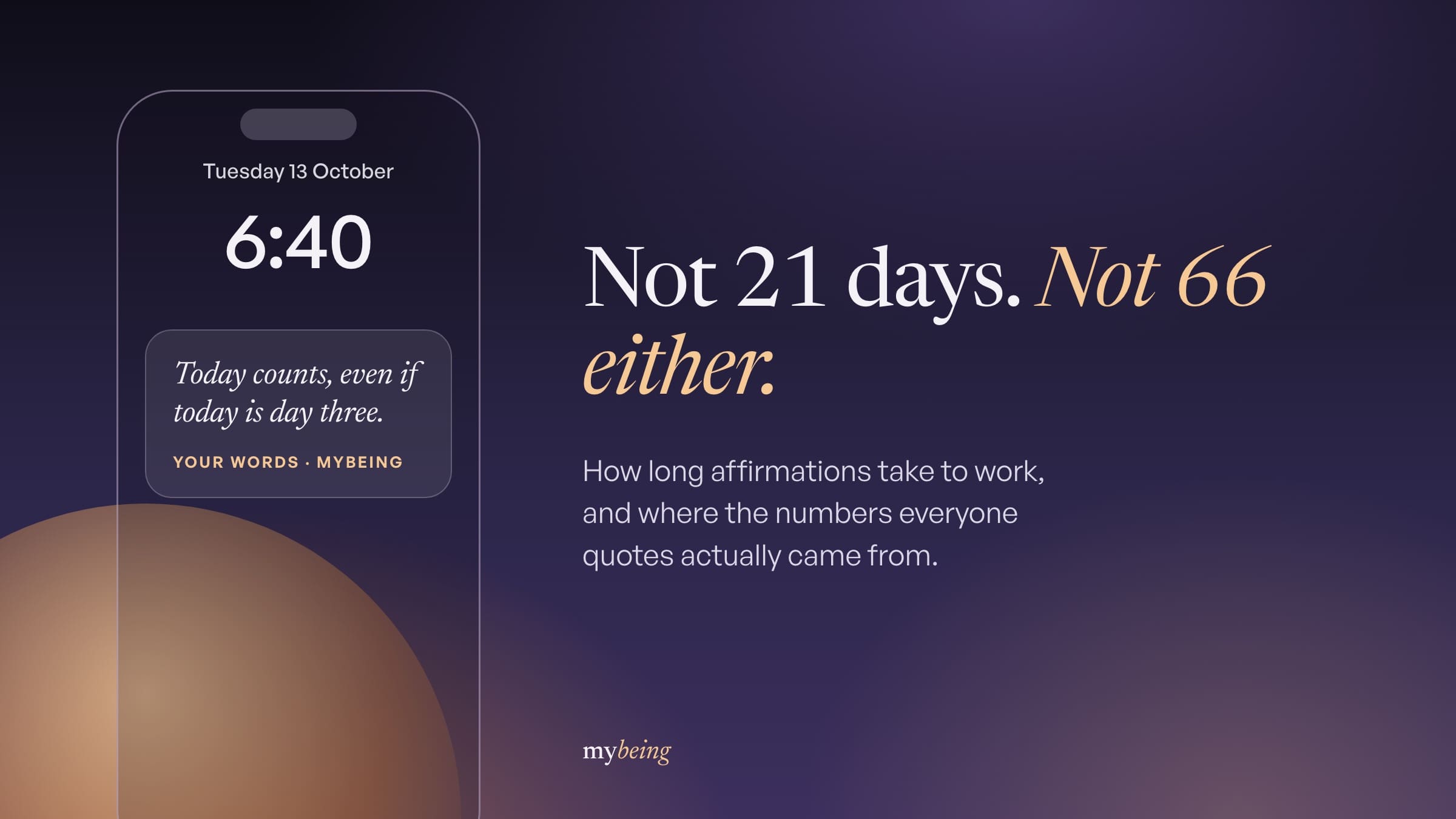
Today counts, even if today is day three.
How long before affirmations show up in your life
Weeks. And one study puts a real number on it.
In 2010 a team led by Akira Miyake ran a study in Science. Students in a university physics class wrote about their values twice, near the start of a 15-week term.
The effect showed up in their end-of-term grades. Two short writing sessions, and the gap between the men's and the women's marks got smaller over the next three months.
Cohen and Sherman's 2014 review found the same shape across dozens of studies. Some effects were still there months later.
Then in October 2025 the biggest piece of work in the field landed. Zhang, Chen, Hu and Wang pooled 129 tests from 67 papers, covering 17,748 people.
Their finding is the clearest answer anyone has. The good effects were both quick and long-lasting.
And for one outcome, the things that hold you back, the later effect was bigger than the early one.
That turns the usual worry on its head. You think nothing is happening yet.
The evidence says some of it turns up later, and turns up larger.
Where the 21-day affirmation rule came from
A plastic surgeon's waiting room, in 1960.
Maxwell Maltz wrote a book called Psycho-Cybernetics. In it he said his patients needed about 21 days to get used to a new face in the mirror.
He was writing about people adjusting to how they looked. Not about habits.
The line escaped the book and turned into a rule. People have repeated it for 65 years without reading the source.
It isn't a finding about affirmations. It isn't one about habits either.
Why the 66-day figure doesn't answer this either
This one is at least a real study. That's what makes it worse.
Lally and colleagues followed 96 people. Each picked one daily thing to do, at the same point each day, for twelve weeks.
The number everyone quotes is a middle figure of 66 days.
Read the paper's own summary and you get something else. It says the time to reach the point where the habit ran by itself ranged from 18 to 254 days.
It also says people vary a great deal, and that it can take a very long time.
The middle number got quoted. The range, which is the real finding, did not.
(We only spotted this because a rival app used the 66-day figure, and we went to check it.)
There's a second problem nobody mentions. The things people practised were eating, drinking and exercise, not saying anything to themselves.
Borrowing a habit number for affirmations is a guess, and a loose one. We'd rather say so than hand you a figure that looks firmer than it is.
How big is the effect you're waiting for?
Small. And knowing that changes what you watch for.
The 2025 study put the size at .32 for how you see yourself, .29 for how you feel in general, and .26 for how you get on with people.
In this field, those count as small.
Nobody writing a "how long" page prints those numbers. They don't sell the wait very well.
But they change the question. You're not waiting for a big change that announces itself.
You're waiting for a small shift in how you talk to yourself. That's the sort of thing you'd miss while watching for something louder.
How to tell if your affirmations are working
The first real sign isn't a feeling. It's the line turning up on its own.
Somewhere in week two or three it arrives by itself. Usually about thirty seconds after something has gone wrong.
That's it starting to work. It's easy to miss, because it doesn't feel like progress.
What comes next is quieter still. The twenty minutes you'd spend going back over the event gets shorter.
Most people only notice that looking back. Which is why the dated note is worth the thirty seconds.
When to stop waiting
There's a point where the honest answer is that this isn't working. You're allowed to reach it.
Give it a month of near-daily contact. If you've also tried smaller, truer wording and nothing has moved, stop.
The one thing that reliably ruins the clock is not seeing the words.
Most people who decide affirmations don't work for them stopped seeing them around day nine.
That's why MyBeing sends one to your Lock Screen each day, rather than leaving it to your memory.
The weeks in the middle, where nothing seems to be happening, are the weeks the evidence says count.
Frequently asked questions
How long does it take for affirmations to work?
Something happens straight away, something else takes weeks, and the habit takes longer than you'd like. In one sitting, researchers have measured a lower stress hormone and better problem solving under pressure. For a change you can see in your results, think in weeks. For it to run by itself, the honest range from habit research is 18 to 254 days.
Is the 21-day rule for affirmations true?
No, and it was never about affirmations. The number comes from Maxwell Maltz, a plastic surgeon who wrote in 1960 that his patients needed about 21 days to get used to a new face. It became a habit rule because people kept repeating it, not because anyone tested it.
What about the 66-day figure?
That comes from a 2010 habit study by Lally and colleagues, and it's a middle figure rather than a rule. The paper's own summary gives a range of 18 to 254 days and says people vary a lot. The study was also about eating, drinking and exercise, not about affirmations.
Will I feel different the first time I say one?
Maybe not, and that's normal. What the lab picked up was in the body and in how people thought, not in how they felt. So you can be steadier under pressure without noticing it.
How do I know if my affirmations are working?
Watch for the line turning up on its own, usually right after something goes wrong. That's the first real sign, and it comes before any change in how you feel.
At what point should I give up on them?
If you've given it a month, tried smaller and truer wording, and nothing has moved at all, that's a fair place to stop. Sticking with a method that doesn't suit you isn't a virtue.