Affirmations
Why don't affirmations work for me? Four reasons, and the fix for each
Affirmations fail when the sentence sits too far from what you believe. Here's the research, the four ways it goes wrong, and 24 rewrites that hold up.
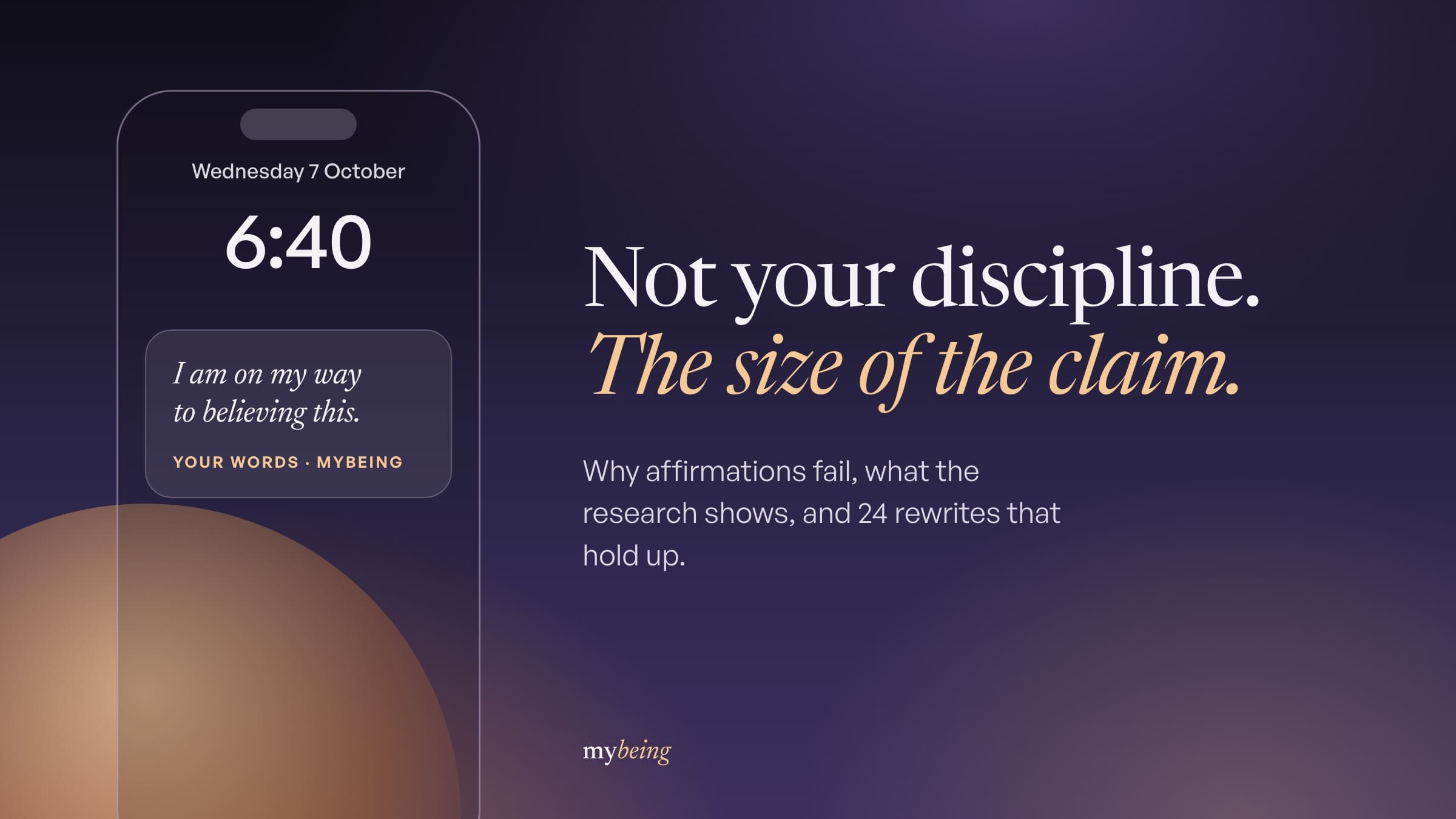
Affirmations usually fail for one reason: the sentence sits too far from what you currently believe, so repeating it measures the gap instead of closing it. That isn't a discipline problem and it isn't yours in particular.
There's a study that demonstrates it directly, a second finding that makes it worse, and four fixes with evidence behind them. If you'd rather start with the definition, what affirmations are covers the ground underneath this.
Why don't affirmations work for me?
Because something in you is checking the claim, and the claim isn't holding up.
Say "I am confident" while you're visibly not and you've handed your own mind a proposition to evaluate. It evaluates it, finds counter-evidence, and presents the counter-evidence.
That's the whole mechanism. The sentence doesn't bounce off, it gets marked.
Most advice on this says to repeat it more. Repeating it more just runs the evaluation again.
What the research says about affirmations backfiring
This is a documented effect rather than a feeling, which is worth knowing if you've been treating it as a personal failing.
In 2009, Wood, Perunovic and Lee asked people to repeat "I'm a lovable person" and measured mood and self-regard afterwards. Participants with high self-esteem improved a little.
Participants with low self-esteem felt measurably worse. The statement sat too far from what they believed, and saying it functioned as a reminder of the distance.
There's a quieter version of the same pattern in the physiological research. Creswell and colleagues found in 2005 that a values-writing exercise lowered cortisol under lab stress, but the effect was moderated by trait self-esteem and optimism.
The people who already had the most in reserve got the most out of it.
I am on my way to believing this.
Why affirmations reward the people who need them least
Put those two findings side by side and you get something nobody selling this will print.
The practice works best for people who were already doing reasonably well, and worst for people in the state that sends them looking for affirmations in the first place.
We make an affirmations app, so this is an awkward thing for us to put halfway up the page. It's also the most useful sentence here, which is why it isn't buried at the bottom.
That's uncomfortable and it's also useful. If you came to affirmations because you felt bad about yourself, you were, statistically, the person least likely to get the advertised result.
So the failure you've experienced is the documented outcome, not an exception to it. The question stops being what's wrong with you and becomes what to say instead.
Four reasons your affirmations aren't landing
Each of these has a different fix, and none of the fixes is more repetition.
The claim is too big. "I am successful" invites an audit you'll lose this morning, so shrink it until nothing in you argues back.
The sentence denies how you feel. "I am calm", said while your chest is tight, is an instruction to stop noticing what you're noticing.
Wegner and colleagues showed in 1987 that telling yourself not to think about a white bear keeps the bear firmly in the room.
The grammar puts you on the hook. "I am" is an assertion you then have to defend, and the defending is where it falls apart.
You're saying it and doing nothing. A sentence about who you are, unattached to anything you'll actually do today, has nothing to attach to, and the ones that stick describe an action instead.
24 affirmation rewrites that hold up
Arranged by the failure they fix. Find the shape of your own sentence and take the version next to it.
(A few of these started out as lines we'd written for other posts and then couldn't say out loud without wincing.)
When the claim is too big
Shrink it until the rebuttal doesn't arrive.
- "I am confident" becomes "I'm allowed to take my turn."
- "I love myself" becomes "I'm learning to be on my own side."
- "I am successful" becomes "I care about doing this well."
- "I am fearless" becomes "I can be nervous and still go in."
- "I am worthy of love" becomes "I don't have to earn basic kindness from myself."
- "I am unstoppable" becomes "I keep going longer than I expect to."
When the sentence denies how you feel
Concede the state first, then say what you'll do inside it.
- "I am calm" becomes "My shoulders are up. I can drop them."
- "I am not anxious" becomes "I can get through the next ten minutes."
- "I release all tension" becomes "I breathe out longer than I breathe in."
- "Nothing bothers me" becomes "This is a lot, and I'm still here."
- "I have no fear" becomes "I'm scared and I'm going anyway."
- "Everything is fine" becomes "This is hard, and hard isn't the same as impossible."
When the grammar puts you on the hook
Ask it instead of asserting it. In 2010, Senay, Albarracín and Noguchi found people performed better on a task after priming themselves with "Will I?" than with "I will."
- "I will finish this" becomes "Will I finish this?"
- "I am disciplined" becomes "What would a disciplined version of today look like?"
- "I am a good father" becomes "How do I want them to remember this evening?"
- "I will stay patient" becomes "Will I stay patient?"
- "I am organised" becomes "What's the one thing that has to happen first?"
- "I am healthy" becomes "What would looking after myself look like today?"
When "I" is the word that sticks
Change the pronoun. Kross and colleagues ran seven studies in 2014 and found that referring to yourself as "you", or by name, creates a small distance that helps under pressure.
Our affirmations for men goes through that research in full.
- "I can handle this" becomes "You've handled worse than this."
- "I am prepared" becomes "You've done the reading."
- "I made a mistake and it's fine" becomes "You made a mistake. One mistake."
- "I am enough" becomes "You're enough for what's actually in front of you."
- "I can speak up" becomes "You've got something worth saying."
- "I'll be okay" becomes "You've been here before and it passed."
What to try instead of affirmations
If the rewrites didn't help either, three things are worth a go before you abandon the idea.
Collect the evidence first. Rather than asserting the conclusion, write down three occasions when the opposite of your worst belief was true, because affirming gets easier once there's something to affirm from.
Write about a value instead of a trait. This is what the research actually tested.
Cohen and Sherman's 2014 review gathered dozens of studies in which people wrote for a few minutes about something they cared about, rather than about how good they were.
Say the smallest true thing. "I'm here" counts, and so does "today I'm going to try."
These sound too small to do anything, which is exactly why they don't trigger the rebuttal.
Where to keep the affirmations that do work
Once you've found a sentence that doesn't trigger the argument, the next failure is simply never seeing it again.
Most people write the good one down somewhere thoughtful and then don't return to it. The journal, the note, the card in a drawer.
Your Lock Screen is the one surface you're already looking at before you've made any decisions about your day. That's where MyBeing puts them, one arriving daily and your own words available whenever the arriving one isn't right.
When affirmations aren't the right tool at all
Sometimes the answer is that this isn't for you, and it's worth someone saying so.
If you've tried the smaller claims, the question form and the pronoun switch and none of it has landed, that's a result. Affirmations are one technique among many and persisting with a bad fit is not a virtue.
There's also a threshold past which no sentence is the right instrument. If this has been heavy for weeks, if it's showing up in your sleep or your appetite, a doctor or a therapist has tools that a phrase doesn't.
MyBeing is not a medical or mental health service. The self-love affirmations go further into the believability problem if that's the part that keeps catching, and the smallest true sentence is still a reasonable place to restart.
Frequently asked questions
Why do affirmations feel fake when I say them?
Because part of you is checking the claim against the evidence and finding it short. That feeling is information about the sentence, not about you. A line close enough to true won't produce it, which is why shrinking the claim usually fixes the fakeness faster than repeating it harder.
Can affirmations actually make you feel worse?
Yes, and it's a documented effect. Wood, Perunovic and Lee had people repeat "I'm a lovable person" in 2009 and found that participants with low self-esteem felt worse afterwards, while those with high self-esteem improved slightly.
Am I doing affirmations wrong?
Probably not in the way you think. The common failures are the claim being too large, the sentence denying how you currently feel, the grammar putting you on the hook to defend it, and saying it without ever acting on it. Each has a specific fix, and none of them is trying harder.
How do I know if an affirmation is too big?
Say it out loud and notice whether anything in you argues back. If a rebuttal arrives before you've finished the sentence, it's too big. Shrink it until nothing answers.
What should I say instead of affirmations?
Three things have research behind them. Ask it as a question rather than asserting it, refer to yourself as "you" or by name, and start from a sentence that concedes where you actually are before it says anything hopeful.
Should I just give up on affirmations?
If you've tried the smaller versions, the question form and the pronoun switch and nothing has landed, then yes, stop. Affirmations are one tool among several and there's no prize for persisting with one that doesn't suit you.