Affirmations
80 affirmations for stress relief, and why "I am calm" backfires
80 affirmations for stress relief, grouped by the moment, plus the research on why telling yourself to be calm is the one instruction that tends to misfire.
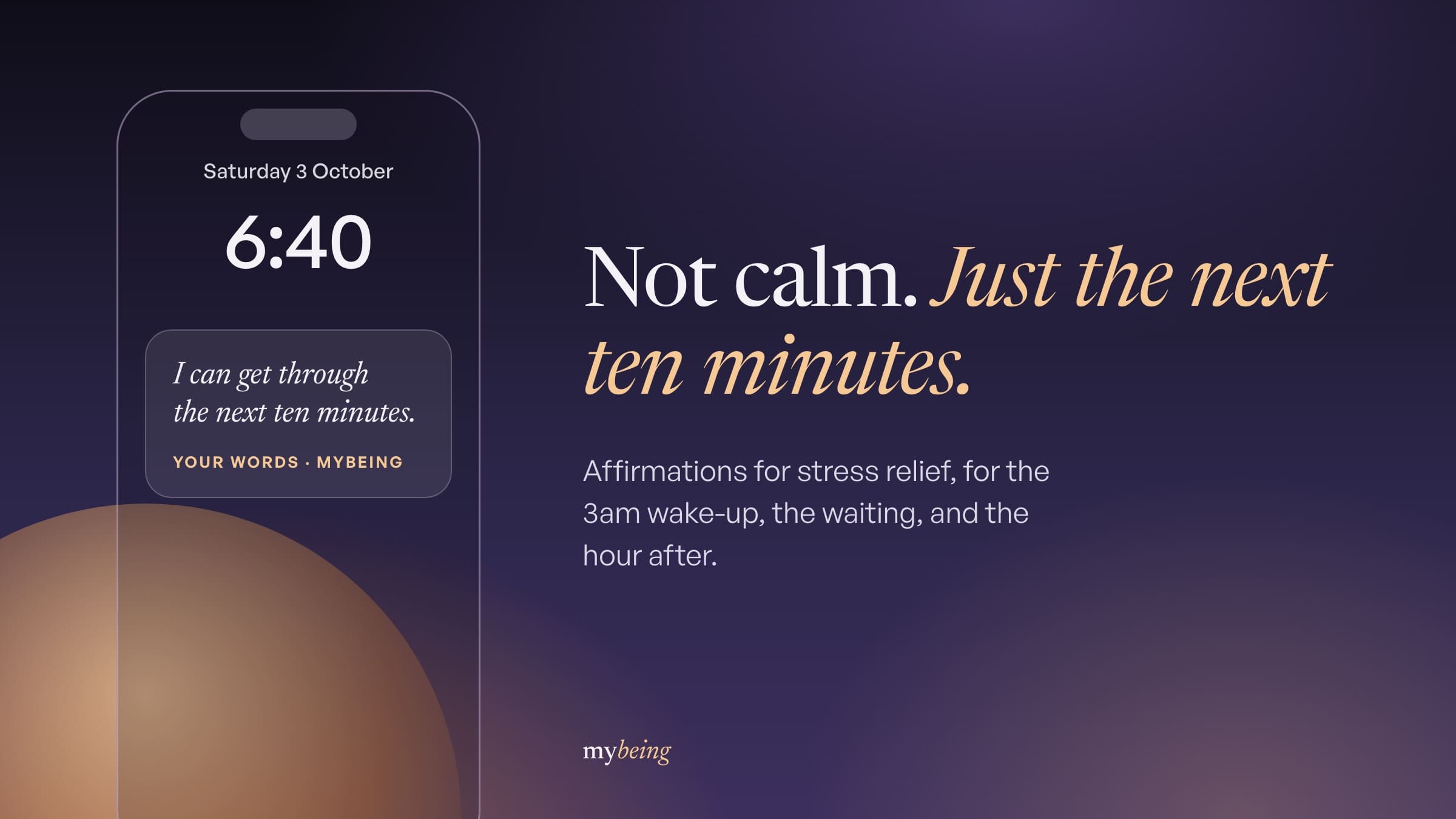
An affirmation for stress relief is a short sentence you say to yourself on purpose when the pressure is up. The useful ones describe what you'll do next rather than how calm you supposedly are.
That distinction matters more than any list. So this starts with the sentence almost every page recommends, and why we think it's the weakest one on offer.
Then 80 affirmations for stress relief, grouped by the moment, and a straight answer about who this helps least.
What is an affirmation for stress relief?
A sentence you choose in advance, for a moment you know is coming.
That's the whole mechanism, and it's narrower than the usual framing. You're not generating calm out of nothing.
You're deciding, while you still have the capacity to decide, what you'd like to be saying at 3am when you don't.
If the pressure you're dealing with is specifically work, the affirmations for the workplace are the narrower list. This one is for the kind that follows you home.
We make MyBeing, which puts an affirmation on a Lock Screen each day, so we read a great many of these lists. Nearly all of them recommend the same handful of lines.
We've come to think the most popular one is a mistake.
Why "I am calm" is the wrong stress affirmation
Because you can hear that it isn't true, and the sentence quietly invites you to check whether it is.
The best-known demonstration of this isn't about affirmations at all. In 1987 Wegner and colleagues asked people to spend five minutes not thinking about a white bear, ringing a bell each time one turned up anyway.
The bears turned up constantly. Instructing yourself away from a thought tends to keep it in the room.
"I am calm" when your chest is tight. "I release all tension."
"I am not anxious." Each one is, in form, an instruction to stop noticing what you're currently noticing.
We should be straight that nobody has run the white-bear experiment on affirmations specifically. So this is an inference rather than a tested finding.
But it fits what people report. And it explains why the lines that land tend to concede the situation first.
Compare:
- "I am calm" becomes "I can get through the next ten minutes."
- "I release all tension" becomes "My shoulders are up. I can drop them."
- "Nothing bad will happen" becomes "If it does, I'll deal with it then."
Each of the second versions accepts the state you're in and gives you something to do inside it. None of them asks you to pretend.
I can get through the next ten minutes.
What does the research on affirmations and stress actually show?
More than you'd expect, and the strongest result is about the body rather than the mood.
In 2005, Creswell and colleagues had eighty-five people either write briefly about a value that mattered to them or do a control task. Then everyone went through a standard laboratory stress challenge.
The group that had written about their values showed significantly lower cortisol. Not lower self-reported mood, lower stress hormone.
Eight years later the same lead author found something adjacent: in a 2013 study, chronically stressed people who did a values exercise then performed better on a problem-solving task under pressure. And the wider base is in Cohen and Sherman's 2014 review, which pulled together dozens of these studies and found effects across health, education and relationships, some lasting months.
The rest of that evidence base is laid out in what affirmations are.
Two caveats, both of which cut against us. What was tested in every one of those studies was a few minutes of writing about what you value, not repeating a sentence at a mirror.
The 2005 result also came with a moderator worth printing. The benefit was largest for participants who already scored high on self-esteem and optimism.
The people with the most in reserve got the most back.
Which leads somewhere uncomfortable, so here it is plainly.
Which stress affirmations backfire?
The ones you can't believe, and the research on that is direct rather than inferred.
In 2009 Wood, Perunovic and Lee had participants repeat "I'm a lovable person" and measured the result. High self-esteem, slight improvement.
Low self-esteem, measurably worse. The sentence sat too far from what they believed, and repeating it worked as a reminder of the gap.
Stack that next to the 2005 moderator and a pattern shows up that no page selling this will tell you. Affirmations tend to reward the people who need them least.
That's not a reason to skip them. It's a reason to pick lines close enough to true that you'd say them without wincing.
And to be wary of any list whose entries you'd be embarrassed to be caught believing.
If the lines that ring false are the ones about you rather than the situation, our self-love affirmations work that problem directly.
How to write a stress affirmation that holds up
Four tests. The first one is doing most of the work.
- Concede the state. Start from where you are. "This is a lot" survives contact with a bad afternoon. "I am serene" does not.
- Describe an action. Something you can do in the next minute, not a mood you're meant to summon.
- Short enough to finish on one out-breath. If you can't, cut it.
- True enough to say to another person. Not that you'd want to. Just that you could.
A trick worth more than it sounds: write the sentence while you're calm, for the version of you who won't be. You're better at this now than you will be at 3am, so do the work now.
80 affirmations for stress relief
Grouped by the moment. Start with the thing that recurs for you.
Then read on, and keep whichever ones land.
For the next ten minutes
Chest tight, heart going, the wave at its highest point.
- I can get through the next ten minutes.
- This is a wave. It peaks and it drops.
- My body is doing something loud. It isn't dangerous to me.
- I breathe out for longer than I breathe in.
- I don't have to fix this feeling to survive it.
- Ten minutes from now this is different.
- I've been here before and I came out the other side.
- I put both feet on the floor and notice them.
- Nothing needs deciding in the next ten minutes.
- I let it be loud and I keep going.
For the 3am wake-up
The racing mind at the worst possible hour, when nothing can be acted on.
- Nothing gets solved at 3am. That's not a failure of mine.
- I'm allowed to put this down until the morning.
- My judgement is worse right now, so I don't trust the conclusions.
- Resting counts, even without sleeping.
- I write it down and let the paper hold it.
- This will look smaller in daylight. It usually does.
- I don't have to win the argument I'm having with nobody.
- The dark makes everything load-bearing. It isn't.
- I'm tired, not in danger.
- Morning me is better equipped. I'll hand it over.
For when there's too much to do
- I do the next thing, not all of them.
- The list being long isn't proof that I'm failing.
- I can only be in one place, doing one task.
- Something will slip. I choose which.
- I say what won't get done, out loud, early.
- Half of this isn't actually mine.
- I'd rather do three things properly.
- Overwhelm is a signal about volume, not about me.
- I stop at a sensible point, not a finished one.
- I ask for more time before I need it, not after.
For money worry
- I look at the number instead of imagining it.
- Avoiding it costs more than facing it.
- I can be worried and still make a plan.
- This month is not every month.
- I've been short before and I got through.
- I ask the question I've been avoiding asking.
- My worth isn't my balance.
- I make one small decision today.
- Not knowing is worse than most answers.
- I'm allowed to talk to someone about this.
For waiting on news
The scan, the result, the decision that isn't yours to make.
- I can't hurry this, so I put it down between checks.
- Worrying isn't preparation. It only feels like it.
- I don't have to rehearse every outcome.
- Today is mine regardless of what Thursday says.
- I'll handle the answer when there is one.
- The waiting is the hard part, and it's temporary.
- I give myself one worry window and then I stop.
- I can be scared and still have a normal afternoon.
- Not knowing is not the same as bad news.
- Whatever it is, I won't be facing it alone.
For when it's someone else's crisis
Caring for someone, and the stress that nobody counts as yours.
- I can be steady without being fine.
- Their crisis is not my fault.
- I'm allowed to need things while they need more.
- I can't pour this out of an empty cup, so I refill.
- Being useful isn't the same as being responsible.
- I say what I can and can't do.
- Resting makes me better at this, not worse.
- I'm allowed to find it hard to watch.
- I can love them and still take an evening off.
- My own life is still happening, and that's permitted.
For the body
The jaw, the shoulders, the stomach, the sleep that won't come.
- My shoulders are up. I can drop them.
- I unclench my jaw.
- My body is reporting a load, not a verdict.
- I eat something, even if I don't feel like it.
- I go outside for ten minutes.
- Tense isn't permanent. It responds to things.
- I breathe low, into the stomach, not the chest.
- Sleep will come when it comes. Lying still counts.
- I move today, briefly, because it changes the chemistry.
- I treat this body like I'm responsible for it.
For after it has passed
The hour afterwards, when the adrenaline leaves and you feel wrung out.
- That was hard. It's reasonable that I'm tired.
- I don't have to perform recovery.
- I did it badly and I still did it.
- The shake afterwards is the system resetting.
- I don't replay it looking for proof of something.
- I'm allowed a flat evening after a steep day.
- One hard day isn't a pattern.
- I did the thing I was dreading.
- I'm kinder to myself after than I used to be.
- Tomorrow doesn't have to be this.
My shoulders are up. I can drop them.
What affirmations for stress relief can't do
A sentence is a sentence. It will not reorganise the thing that's causing the stress, and it isn't treatment for anything.
If the pressure is coming from a workload, a bad financial month or somebody else's behaviour, words change how you talk to yourself about it. They leave the cause exactly where it was.
Use the sentence for the second conversation, the one you have with yourself afterwards. Use something else for the situation itself.
There's a line past which this stops being the right tool. If stress has been sitting on you for weeks rather than days, if it's moved into your sleep or your appetite or your chest, if you've stopped doing things you used to enjoy, or if you're drinking to take the edge off, that's the point to talk to a doctor.
Not as a last resort, and not because anything is wrong with you. Persistent stress is something medicine has useful answers for, and a list of sentences is not one of them.
Doing both at once is normal. The sentences get easier to keep up once something is actually being done about the cause.
Where to keep your stress affirmations
Somewhere you'll see them at the moment you need them, which rules out most of the usual advice.
A journal is no help at 3am. A printable on the fridge is no help on a train.
The notes app would be perfect, except you'd have to decide to open it. At the point where you most need this, you won't be making good decisions about anything.
(We've all got a note somewhere with a plan in it that we have never once opened while the plan was live.)
The phone is already in your hand during almost every moment this list is written for. That's where MyBeing puts them: one arrives each day, and you can write your own for whatever's currently happening, so the words are on the Lock Screen before you've decided to look for them.
Your first week of stress affirmations
- Day 1. Start with the group matching whatever recurs for you, and read past it. Keep what lands.
- Day 2. Say one on a slow out-breath when nothing is wrong. Practising it calm is the point.
- Day 3. If a line makes you wince, it's too far from true. Pull it closer.
- Day 4. Use one in a real moment. It'll feel like it didn't work. Note what you said anyway.
- Day 5. Nothing. Stress habits that demand daily effort get dropped in the first difficult week.
- Day 6. Reread your two. Change the wording if the real moment taught you something.
- Day 7. Keep the same two for a month before deciding anything.
What you're going for isn't a quieter nervous system on demand. It's having something prepared, so the ten worst minutes come with a sentence in them that you chose in advance, rather than whatever your brain produces unsupervised at three in the morning.
Frequently asked questions
Why doesn't "I am calm" work when I'm stressed?
Because you can hear that it isn't true, and the sentence invites you to check. Wegner and colleagues showed in 1987 that instructing yourself not to think about something tends to keep it present rather than removing it. A line describing what you'll do next, like "I can get through the next ten minutes", doesn't ask you to deny anything.
Do affirmations for stress relief have any evidence behind them?
Some, and it's about the body as much as the mind. In 2005 Creswell and colleagues had people write briefly about a personal value before a stressful lab task, and that group showed significantly lower cortisol than the control group. What was tested was a few minutes of writing about values, not repeating a phrase, which is a distinction most pages on this subject skip.
How quickly do stress affirmations work?
For the acute moment, a sentence can give you something to hold while the physical wave passes, which is usually minutes. For anything longer, think in weeks, and be sceptical of anyone offering a timeline.
Who do they work least well for?
This is the uncomfortable bit. Creswell's 2005 study found the effect was moderated by trait self-esteem and optimism, meaning the people with the most to spare got the most out of it. Wood and colleagues found in 2009 that people with low self-esteem felt worse after repeating a positive statement they didn't believe. If a line rings false, that's information about the line.
Should I say them out loud or breathe with them?
Either. Pairing a line with a slow out-breath gives you something to do with the ten seconds, which helps more than the wording does. Out loud is optional and faintly ridiculous in an open-plan office, so read it instead.
Are these a substitute for seeing someone?
No. They're a way of choosing your words. If stress has been sitting on you for weeks, or it's showing up in your sleep, your appetite or your body, a doctor is the right call. MyBeing is not a medical or mental health service.