Affirmations
120 self-love affirmations, and how to say them without cringing
120 self-love affirmations sorted by the moment you need them, how to write one you actually believe, what to do when they feel fake, and where to keep them.
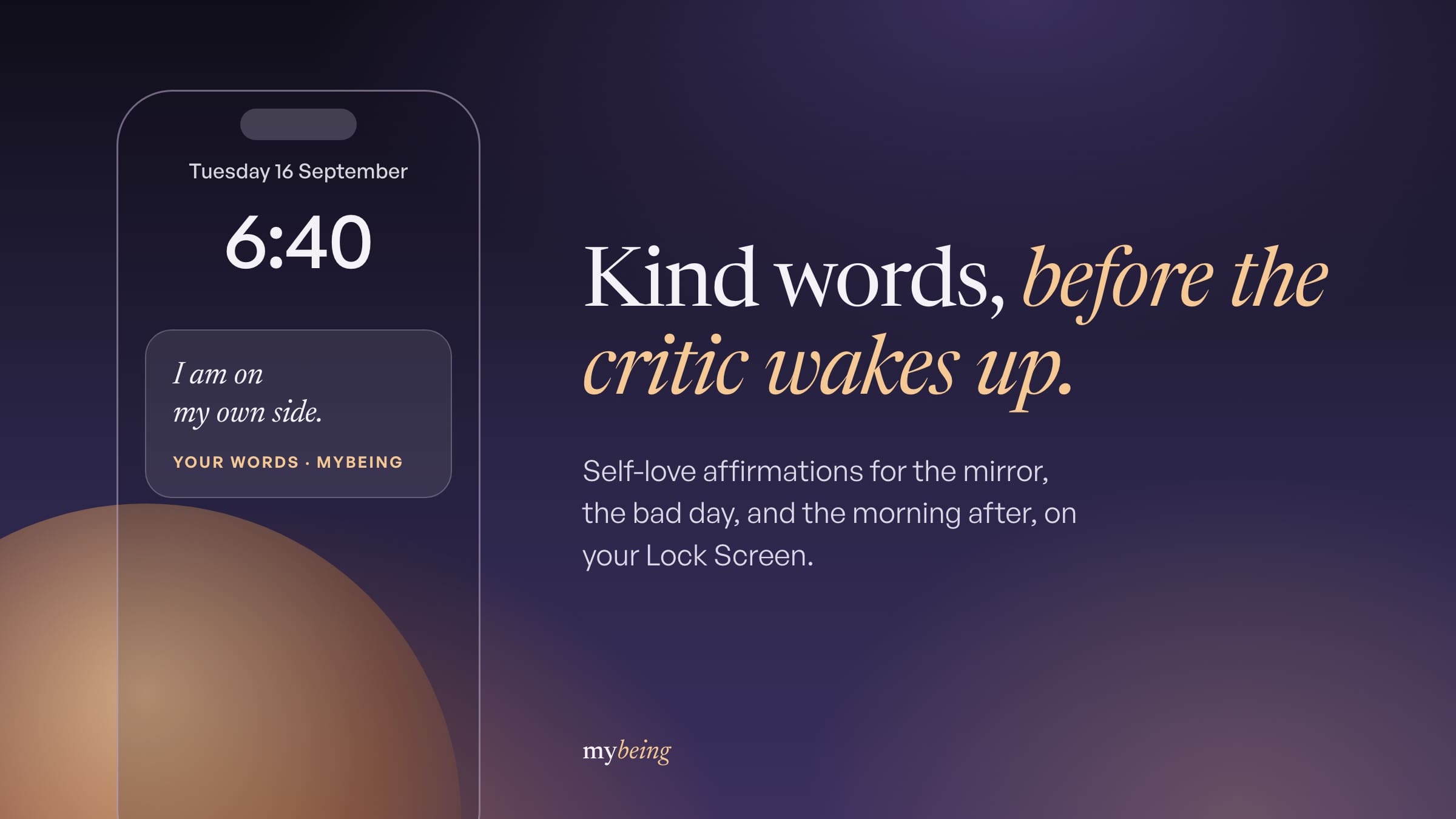
A self-love affirmation is a short, present-tense sentence that treats you the way you'd treat someone you care about. Not a compliment, and not a slogan.
A sentence like "I'm on my own side today", said on purpose, at a moment when the voice in your head is about to say something else. Below are 120 of them, sorted by the moment you'll need them, and a plain way to choose, write, and keep the ones that turn out to be yours.
What is a self-love affirmation, and what isn't it?
It's a sentence you say to yourself in the voice you'd use for a friend. That's the whole definition, and it's stricter than it sounds.
You wouldn't tell a friend "you are a radiant goddess of abundance" at 6:40 in the morning. You'd say "you did fine yesterday, get up, I made coffee."
Self-love is not self-esteem. Self-esteem is a verdict: how good am I, how do I rank.
Self-love is how you treat yourself whatever the verdict says. That distinction matters for affirmations, because verdict sentences ("I am amazing") collapse on a bad day and treatment sentences ("I'm allowed to have a bad day") don't.
If what's actually pressing on you is pressure rather than self-regard, the affirmations for stress relief are the better list.
And it's not positive thinking. You're not trying to believe the day will go well.
You're deciding how you'll speak to yourself while it goes however it goes.
We make MyBeing, which delivers an affirmation to a Lock Screen daily and lets you put your own words there instead, so this distinction is one we argue about more than you'd think.
Do self-love affirmations actually work?
Some do, for some people, and there's a well-known study about the ones that don't.
In 2009, Wood, Perunovic and Lee had people repeat "I'm a lovable person" and measured how they felt afterwards. People who already had high self-esteem felt a little better.
People with low self-esteem felt worse. The sentence was too far from what they believed, and repeating it mostly reminded them of the gap.
That study is why the list below avoids the biggest claims, and why we'd rather you soften a line than force one.
The research on self-affirmation more broadly is steadier, though it studies something a bit different: people writing for a few minutes about a value they hold.
That whole body of work is summarised in what affirmations are. Cohen and Sherman's 2014 review found that these brief exercises improved outcomes in health, education and relationships, with some effects lasting months.
Cascio and colleagues, in 2016, watched it happen in a scanner. The regions that lit up were the ones tied to reward and to thinking about yourself.
Falk and colleagues, in 2015, found people who'd affirmed themselves went on to change their behaviour more than people who hadn't.
Put those together and you get the rule this whole post runs on. Affirm what you value and what's true.
Don't affirm what you wish were true.
I am on my own side.
How to write a self-love affirmation you can say without cringing
The cringe is information. It means the sentence is too big, too vague, or too far from where you are.
Four tests fix most of it.
- Present tense. "I treat myself gently", not "I will learn to love myself."
- A treatment, not a verdict. "I'm allowed to rest" rather than "I deserve everything."
- True enough. If it makes you wince, shrink it until it doesn't. "I love myself" can become "I'm learning to be on my own side." That's not a lesser sentence. It's the honest one, and honest ones are the ones you'll keep saying.
- For a moment. "I'm kind to myself after I make a mistake at work" beats "I am kind to myself." Name where it happens.
A few rewrites:
- "I am worthy of love" becomes "I don't have to earn kindness from myself."
- "I love my body" becomes "My body got me through today, and I can thank it."
- "I am perfect as I am" becomes "I don't need fixing before I'm allowed to be decent to myself."
And a trick we keep coming back to: write the sentence you'd say to your closest friend on their worst morning. Then change "you" to "I".
How many self-love affirmations, and which ones?
As many as you can read before your attention goes.
Read one group below, the one that matches the moment that's hardest for you, and say each line under your breath. Keep the ones you can say without your shoulders going up.
Skip the rest. If nothing fits, take the nearest one and run it through the four tests until it does.
Then give those ones four weeks of mornings, and keep reading the rest as you go.
120 self-love affirmations
Every line is written to pass the four tests. Some pass more comfortably than others, and you'll feel which.
Read through. Keep the ones that land.
For the mirror
The first look of the day, before anyone else's eyes are on you.
- I meet the day as I am.
- I'm on my own side today.
- This face has carried me through every day so far.
- I don't need to look different to be treated kindly by me.
- I can look at myself without a running commentary.
- Good morning. I'm glad it's you.
- I'm allowed to like what I see.
- I don't owe anyone a better version of my face.
- I greet myself before I judge myself.
- I am someone worth being gentle with.
For when you've been hard on yourself
The morning after you replayed the conversation eleven times.
- I'm learning to speak to myself the way I speak to a friend.
- One mistake is one mistake.
- I can be wrong without being worthless.
- The voice that says I'm not enough is a habit, not a fact.
- I forgive the version of me who didn't know yet.
- I notice the critic and I don't hand it the microphone.
- I'm more than my worst hour.
- I get to tell yesterday's story kindly.
- I answer harshness with evidence.
- I did what I could with what I had.
For your body
Not for loving every part of it. For being on speaking terms with it.
- My body got me through today, and I can thank it.
- I don't have to earn food, rest, or comfort.
- I take care of this body because it's mine, not because it's finished.
- I can be tired without being lazy.
- I speak about my body the way I'd want my child to hear.
- I'm allowed to take up the space I take up.
- I feed myself like someone I'm responsible for.
- My worth doesn't change with the number on anything.
- I move because it feels good, not as a punishment.
- This body deserves clothes that fit it today.
For saying no
For the invitation you said yes to when you meant no, and the next one.
- I can say no in one sentence.
- My time is mine to give, not owed.
- I can disappoint someone and still be a good person.
- I don't explain a no I've already given.
- I'm allowed to change my mind.
- Protecting my energy is not selfish. It's maintenance.
- I decide what I can carry.
- I can love people and still leave the party early.
- I'm not responsible for other people's reactions to my limits.
- Every no makes room for a yes I mean.
For being alone
A quiet flat. Dinner for one.
The Sunday with nothing in it.
- I'm good company, including for myself.
- Alone is not the same as unwanted.
- I can enjoy my own attention.
- I don't need an audience to have a good evening.
- I'm building a life I'd want to come home to.
- I can sit with myself without reaching for a screen.
- Being with me is a fine way to spend a Sunday.
- I'm not waiting for someone to make me feel real.
- My own approval counts.
- I'm at home in myself tonight.
For after a mistake
For the email you shouldn't have sent, the thing you said, the deadline you missed.
- I made a mistake. I am not a mistake.
- I can repair this without punishing myself first.
- I'm allowed to be new at this.
- The fix starts when I stop replaying it.
- I'd forgive a friend for this by now.
- I can hold the lesson and drop the shame.
- This is one line in a long story.
- I did a hard thing badly, and that's still doing a hard thing.
- I get to decide what this means.
- I'm steadier than I was before this.
For when you're comparing yourself
For the scroll. The photo you almost didn't post.
The friend who got the thing you wanted.
- Someone else's morning is not my measure.
- I'm running my own race, at my own pace, on my own road.
- What I see online is a highlight reel, and I know it.
- I can be happy for them and still want things for me.
- My progress counts even when it doesn't photograph.
- I'm not behind. I'm on my own timeline.
- There's room for me, and them, and everyone.
- I put the phone down and I'm still here.
- I measure myself against last year's me, not the feed.
- What I have is enough to start with.
For your work and your worth
The desk, the review, the job that has been quietly telling you what you're worth. There's a fuller set in our affirmations for the workplace, including what to say after criticism.
- My worth is not my output.
- I can do good work without being defined by it.
- I'm allowed to rest before I've finished everything.
- I ask for what I'm worth in one sentence.
- I don't have to be the best to be good at this.
- I know more than I did last year.
- I can say "I don't know yet" and keep my seat.
- A bad week at work is a bad week, not a bad me.
- I finish what I start, even roughly, and that's enough.
- I bring something to every room I walk into.
For being cared for
For the compliment you deflected, the help you refused, the love you weren't sure you were owed.
- I can let kindness land.
- I don't have to earn being cared for.
- "Thank you" is a whole sentence.
- I let people help me.
- I'm allowed to be loved before I've fixed myself.
- Accepting care is not weakness.
- I don't have to deflect a compliment to be humble.
- I can be the one who's looked after today.
- I let people see me, including the tired parts.
- I'm worth the trouble.
For rest
Guilt about the evening. Guilt about the morning.
Mostly just guilt.
- Rest is not something I earn. It's something I need.
- I can stop before I'm empty.
- Doing nothing is doing something for me.
- I don't have to be productive to be allowed to sit down.
- My worth doesn't clock out when I do.
- I can take the slow morning.
- I'm allowed to be tired.
- Sleep is part of the work.
- I don't need permission to close the laptop.
- Tomorrow will be better with me rested.
For the past
What you did, what was done to you, and the version of you who lived through both.
- I did the best I could with what I knew.
- I'm not who I was, and I'm allowed to have been that.
- I can look back without going back.
- What happened to me is not what's wrong with me.
- I hold my younger self gently.
- I don't have to relitigate the past every morning.
- I survived every day so far.
- I can forgive myself for what I didn't know.
- My story is still being written, and I'm holding the pen.
- I carry what's useful and I set the rest down.
For the morning
For the first ten seconds, before the day has an opinion. The morning affirmations for confidence go further on this one.
- I choose my words, and I choose these.
- I start the day on my own side.
- I can handle what today brings.
- I'm ready enough.
- Today asks for my attention, not my perfection.
- I'll speak to myself kindly today, especially if I fail.
- I begin before I feel ready, because that's when beginning happens.
- I'm allowed to have an ordinary day.
- I trust myself to figure out the parts I can't see yet.
- I'm glad it's me who gets to live this day.
I don't have to earn kindness from myself.
What to do when your affirmations feel fake
Shrink them. That's the whole answer, and it's the one the research points to.
If "I love myself" makes you feel like a liar, you're not doing it wrong. Wood and colleagues found exactly that: the further the sentence sits from what you believe, the more it backfires.
So step it down. "I'm learning to be on my own side" is closer.
"Today I won't pile on" is closer still. Find the sentence you can say without your shoulders going up, and say that one, even if it's small.
Small and true beats big and hollow every morning of the week.
There's a second fix, and it isn't shrinking. Try changing the pronoun: "you're learning to be on your own side" instead of "I'm learning".
Kross and colleagues found that small distance helps people handle things better, and it works for anyone.
Those are two of four. Why don't affirmations work for me sets out all of them, with the studies attached.
We'd add one more thing, because Cosmopolitan is right that it can feel cringey at first. Cringe is usually about being watched.
Say them where no one is. The shower.
The Lock Screen. Under your breath at the sink.
Where to keep self-love affirmations where you'll see them
None of this survives contact with a normal week unless the words are somewhere you already look. Most guides end before this bit, which has always seemed backwards to us.
Cards propped on the bathroom shelf do fine until the day they get moved to make room for something else. The mirror note fades into the mirror.
And the note buried in your phone requires you to go and find it, which nobody does on the morning they need it most. (Ours was called "self love", lowercase, and we opened it about as often as a terms-and-conditions page.)
The place most people look first each day is the Lock Screen of their phone. That's where MyBeing puts them.
One arrives each morning by itself, and when it isn't the right one you write your own over the top. Either way the words reach your Lock Screen and Home Screen before your inner critic has had its coffee, and you never have to remember to go looking.
Your first week of self-love affirmations
You don't need a system. You need seven ordinary mornings.
- Day 1. Read the group that matches your hardest moment, then keep going. Put whatever lands where you'll see it.
- Day 2. Say them at your anchor: the kettle, the first look at your phone, the sink. Ten seconds.
- Day 3. If one feels like acting, shrink it. Don't swap it.
- Day 4. Flat morning. Say them anyway. Flat is most mornings.
- Day 5. Somewhere in the day, one of the lines will show up on its own, usually right after you've been unkind to yourself. Notice that. That's it starting to work.
- Day 6. Say them. That's all.
- Day 7. Decide to keep going for three more weeks. Don't add lines yet.
If you've already got a morning affirmation habit going, these slot into the same ten seconds. Don't add a second slot.
Swap one line.
What self-love affirmations are not
They're a way of choosing your words, and that's the whole of the claim. No sentence here treats anything, and none of it stands in for talking to a professional when you need one.
If the voice in your head is heavy in a way that words don't reach, start with a doctor or a therapist. Plenty of people do both at once, and the two don't compete.
They're also not a way to make yourself feel a particular thing. None of the 120 lines above promise a feeling.
They describe how you intend to treat yourself, which you can do on a day when the feeling doesn't turn up.
Two sentences. One place you already look.
Four weeks before you judge any of it.
Frequently asked questions
What if saying 'I love myself' makes me feel worse?
Then don't say that one. Research by Wood and colleagues in 2009 found that people with low self-esteem felt worse after repeating a very positive statement they didn't believe. Pick a sentence that's true enough, like 'I'm on my own side today', and work up from there.
What's the difference between self-love and self-esteem?
Self-esteem is a verdict on how good you are. Self-love is how you treat yourself regardless of the verdict. Affirmations for self-love are about the treatment, which is why they hold up on a bad day when self-esteem doesn't.
How many self-love affirmations should I use?
As many as you can read without it becoming a task. The ones that land are worth meeting every morning, and meeting them often is where the effect lives.
Do I have to say them out loud, or in the mirror?
No. Reading them slowly works. Some people like the mirror, some find it excruciating, and both are fine. The thing that matters is that you see them at all, which is mostly a question of where you keep them.
How long before self-love affirmations make a difference?
Honestly, nobody can give you a number and the research doesn't either. Most people notice the habit first, and then, weeks later, notice that the voice in their head has gotten a little less harsh. Give it a month.
Are self-love affirmations a form of therapy?
No. They're a way of choosing your words. If you're struggling, a therapist or a doctor is the right next step, and affirmations can sit alongside that. MyBeing is not a medical or mental health service.