Affirmations
What are affirmations, and do they actually work?
What affirmations are, how they differ from mantras and manifesting, what six studies actually found, and who they reliably don't work for.
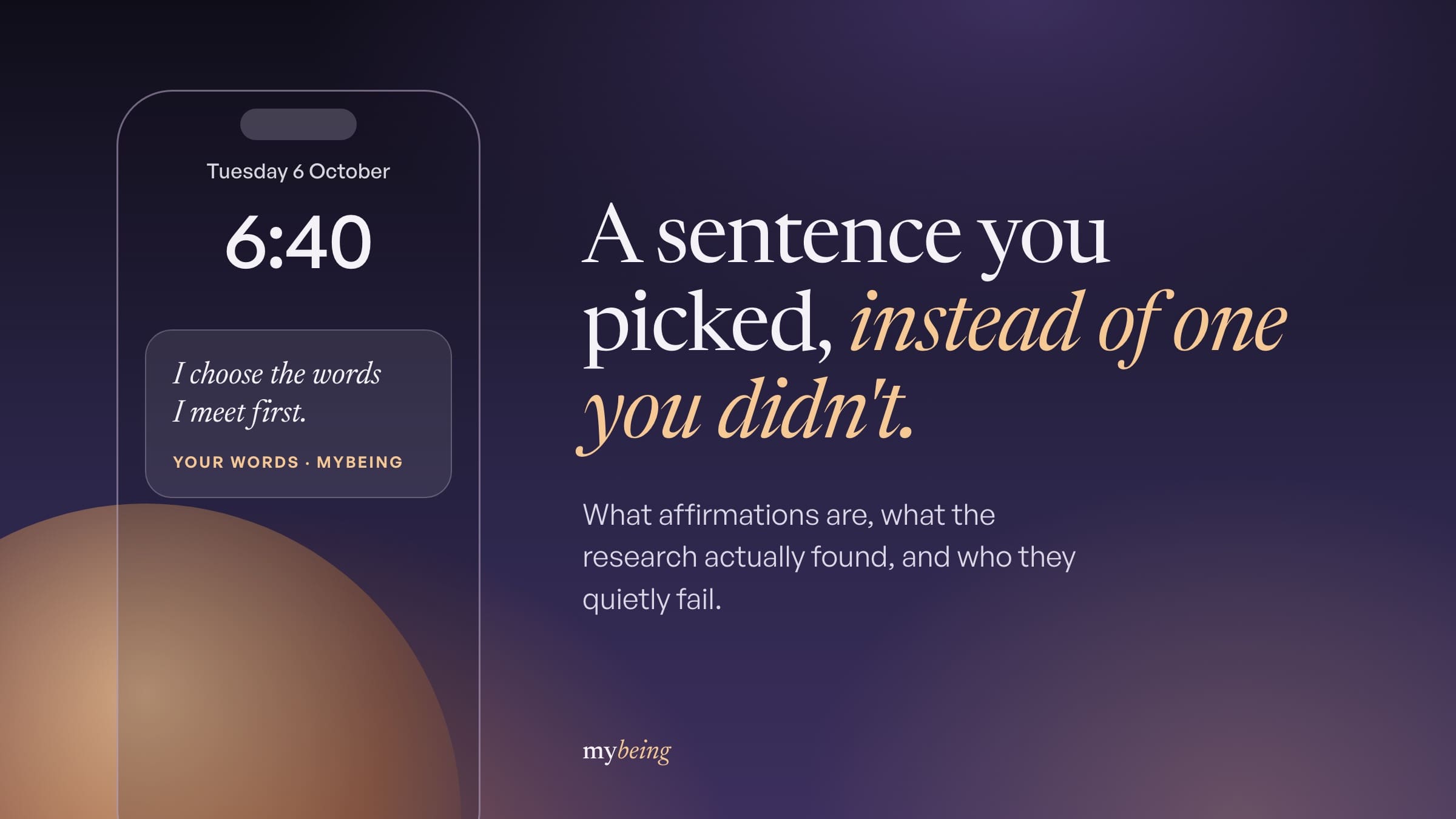
An affirmation is a short sentence you choose in advance and then say to yourself deliberately, describing how you intend to act or what you value. The chosen-in-advance part is the whole of it, because the rest of your self-talk you don't choose at all.
That's a narrower definition than most pages give, and the narrowness is the point. Below: what affirmations are not, what six studies actually found, who they reliably fail, and how to write one.
What are affirmations, exactly?
A sentence you picked, standing in for one you'd otherwise have produced automatically.
Most of what runs through your head about yourself was never selected. It's old, repetitive and frequently unkind, and it arrives without being asked for.
An affirmation is a small act of substitution. You decide, while calm, what you'd like to be saying at the moment you won't be calm.
Three things follow from that definition, and they rule out most of what gets sold under the name.
It has to be short, because you have to be able to recall it under pressure. It has to be about you rather than about events, because events aren't yours to assert.
And it has to be close enough to true that you can say it without flinching. That last one is doing more work than it looks, and we'll come back to it.
If you already know roughly what you want and you're looking for lines rather than definitions, our morning affirmations for confidence is the most general of the lists.
What affirmations are not
Three things get confused with affirmations, and the confusion is most of why people think the whole idea is silly.
Not a mantra. A mantra is typically a word or sound repeated to occupy attention during meditation, and its literal meaning is often beside the point.
An affirmation is the opposite. The meaning is the entire point, and there's no benefit to repeating one you don't follow.
Not manifesting. Manifesting expects the words to change what happens, which is a claim about the universe.
An affirmation makes a claim about you, which is a claim you can act on and check.
"I'll ask for the thing" is an affirmation. "The money is on its way to me" is not.
Not positive thinking. Positive thinking asks you to believe the outcome will be good.
An affirmation describes how you intend to meet whatever outcome turns up. One requires optimism and the other doesn't, which is why the second survives a bad week.
I choose the words I meet first.
Do affirmations actually work?
There's a real body of evidence, and it's both better and narrower than you'll read elsewhere.
The field is called self-affirmation, and the studies mostly share one design. People spend a few minutes writing about a value that matters to them, often family or honesty or being good at their work, and then do something difficult.
Cohen and Sherman's 2014 review in the Annual Review of Psychology gathered dozens of these. It found effects across health, education and relationships, with some of them still measurable months later.
The more striking results are physiological. Creswell and colleagues found in 2005 that people who'd done the writing exercise had significantly lower cortisol during a laboratory stress task.
By 2013, the same lead author found chronically stressed participants solved problems better under pressure afterwards. That second study is the one Everyday Health describes without naming, in the sentence about problem-solving under stress.
Cascio and colleagues put people in a scanner in 2016 and watched the exercise light up the regions tied to reward and to thinking about yourself. And Falk and colleagues found in 2015 that people who'd affirmed themselves responded differently to health messages and then actually changed their behaviour more.
Now the caveat that nearly every page on this subject omits. What was tested in all of those studies is a few minutes of writing about what you value, not repeating a phrase at a mirror.
Whether the second produces the first is genuinely less well established. We think it's a reasonable extension and we'd rather say so than imply the evidence is tighter than it is.
If you've tried affirmations and got nothing, why don't affirmations work for me takes that apart in detail.
You'll also meet neuroplasticity invoked as the mechanism, usually without a source. It isn't wrong exactly, but used that way it's decoration rather than explanation.
(We went looking for the study behind those mentions and found mostly other pages making the same mention.)
Where did the idea come from?
Not from self-help, which surprises people.
The research tradition starts with the psychologist Claude Steele, who proposed self-affirmation theory in 1988. His argument was that people are motivated to maintain a view of themselves as broadly good and capable, and that reflecting on a value you hold restores that view when something has threatened it.
Everything measured since sits on that idea. It's also why the studies ask people to write about values rather than to assert flattering things, a distinction the popular version of affirmations lost somewhere along the way.
The sharpest single demonstration is one we walk through in the affirmations for women: a brief values-writing exercise in a university physics course narrowed the gap between men's and women's performance over a term.
Who do affirmations not work for?
People who don't believe them, and the evidence on that is unusually direct.
In 2009, Wood, Perunovic and Lee asked participants to repeat "I'm a lovable person" and measured how they felt afterwards. Those with high self-esteem improved slightly.
Those with low self-esteem felt measurably worse. The sentence sat too far from what they believed, and saying it functioned as a reminder of the gap.
There's a second, quieter version of the same pattern. Creswell's 2005 cortisol result was moderated by trait self-esteem and optimism, meaning the benefit was largest for the people who already had the most in reserve.
Put those together and you get something no page selling affirmations will tell you. The practice tends to reward the people who need it least.
That isn't a reason to skip it. It's a reason to choose sentences close enough to true that you'd say them in front of someone, which is the whole method in one line.
If the sentences that ring false are the ones about your own worth, our self-love affirmations deal with that specific problem at length.
How do you write an affirmation?
Four tests, and the fourth is the one most lists ignore.
Present tense. "I take my turn", not "I will get better at speaking up", because the morning is for who you are today.
An action or a value, not a verdict. "I do the work because I care about it" survives a bad day, where "I am successful" collapses on contact with one.
Attached to a moment. Name where it happens: the 9am, the mirror, the email you've read four times.
True enough to say out loud. If it makes you wince, shrink it until it doesn't, so "I am confident" becomes "I'm allowed to take my turn" and you're still saying it in March.
There's also a trick with the pronoun that has better evidence behind it than most of this. Saying "you" instead of "I" creates a small distance that helps under pressure, and our affirmations for men goes through the studies.
30 affirmations to start with
Short, deliberately. If you want eighty of something, the lists linked through this piece are built for that.
For the morning
- I start the day on my own side.
- Today asks for my attention, not my perfection.
- I'm ready enough.
- I can handle what today brings.
- I begin before I feel ready.
- The first hour is mine.
- I'd rather start than be certain.
- I'm not behind yet.
- I do the first thing without negotiating.
- I choose the words I meet first.
For when you're being hard on yourself
- I speak to myself the way I'd speak to a friend.
- One mistake is one mistake.
- I can be wrong without being worthless.
- I'm more than my worst hour.
- I forgive the version of me who didn't know yet.
- I don't have to earn the right to rest.
- The critic is a habit, not a fact.
- I'm allowed to take up space.
- I did what I could with what I had.
- I answer harshness with evidence.
For pressure
These ten are condensed from the affirmations for stress relief, which explains why "I am calm" is usually the wrong line to reach for.
- I can get through the next ten minutes.
- I do the next thing, not all of them.
- I can be stressed and still think straight.
- This is a wave. It peaks and drops.
- I say what won't get done, early.
- My shoulders are up. I can drop them.
- Nothing needs deciding in the next ten minutes.
- I'm tired for a reason, and the reason isn't weakness.
- I stop at a sensible point, not a finished one.
- I've been here before and came out the other side.
Those three groups map onto the three things people actually search for. If the pressure in your life is mostly coming from your job, the affirmations for the workplace are sorted by the work moment instead.
How often should you say them?
Daily, and as many as you can take in before it starts feeling like a task.
There's no correct number. The useful limit is attention: a line you actually mean does more than one you skim past, and the way you find the ones you mean is by meeting plenty of them.
So read until something catches. The ones that catch are worth coming back to, and the coming back is where the repetition in those studies does its work.
Ten seconds is enough on a morning when that's all there is. On a slower one, keep reading.
Where do you keep them?
Wherever it is, it has to be somewhere you already look, which rules out most of the standard advice.
A note on the mirror works for about a week and then becomes part of the mirror. A journal works if you were already opening a journal.
The phone is where almost everyone looks first. That's the whole idea behind MyBeing: an affirmation arrives on your Lock Screen each day, and you can write your own, so the first words you read are ones you picked rather than whatever arrived overnight.
What affirmations can't do
They're a way of choosing your words, and that's the entire claim.
They don't treat anything, and they don't reorganise the situation producing the difficulty. If you're underpaid, overloaded, or struggling in a way that words don't reach, the sentence changes the second conversation and leaves the first one exactly where it was.
If something has been heavy for weeks rather than days, a doctor or a therapist is the right next step. MyBeing is not a medical or mental health service, and doing both at once is entirely normal.
Start with whatever you can say without wincing, and keep meeting new ones until more of them land. The part that decides it is whether they reach you somewhere you'll actually see them.
Frequently asked questions
What is an affirmation, in one sentence?
A short sentence you choose in advance and say to yourself on purpose, describing how you intend to act or what you value, rather than what you hope will happen. The chosen-in-advance part is what separates it from ordinary self-talk, which you don't choose at all.
What's the difference between an affirmation and manifesting?
An affirmation describes how you'll meet a situation. Manifesting expects the words themselves to change what the situation is. The first makes a claim about you, which you can act on. The second makes a claim about the universe, which you can't check.
Is an affirmation the same as a mantra?
No. A mantra is usually a word or sound repeated to hold attention during meditation, and its meaning is often beside the point. An affirmation is a sentence whose meaning is the entire point.
Do affirmations actually work?
Some do, for some people, and the honest version is narrower than most pages suggest. The research base is on self-affirmation, where people write briefly about a value they hold, and it has found lower cortisol under stress and better problem-solving under pressure. Whether repeating a phrase produces the same effect is less well tested.
Who do affirmations not work for?
People who don't believe the statement. Wood and colleagues found in 2009 that participants with low self-esteem felt measurably worse after repeating a positive line about themselves. The further a sentence sits from what you already believe, the more repeating it draws attention to the distance.
How long does it take for affirmations to work?
Nobody can give you a credible number, and a page offering one is guessing. Most people notice the habit before they notice any change in how they talk to themselves. A month is a reasonable point at which to judge it.