Affirmations
120 positive affirmations for women, sorted by the moment
120 positive affirmations for women, grouped by the moment you need them, with the research on which ones work and the kind that quietly backfire.
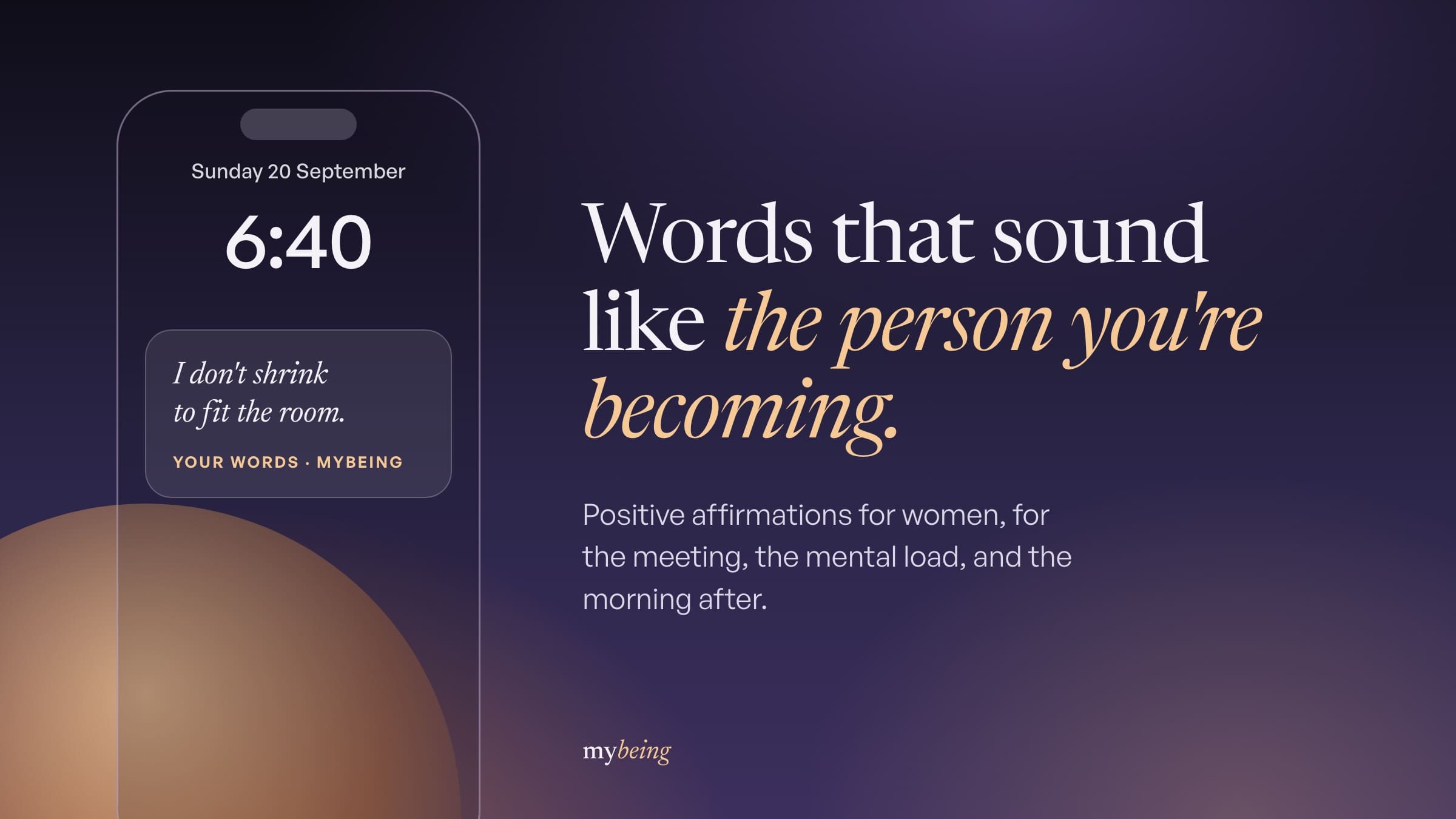
Positive affirmations for women are short, present-tense sentences you say to yourself on purpose, written for the moments where the day quietly asks you to be smaller. The ones that hold up are specific, true enough to say out loud, and built on something you actually value.
Below are 120, sorted by the moment rather than the mood, plus what the research says and the kind of sentence that makes things worse.
What makes an affirmation work for a woman in particular?
Nothing in the grammar. The difference is the moment it's written for.
Most affirmation lists are written for a generic bad mood, which is why they end up sounding like posters. The situations women describe are more specific than that: getting talked over at 11:15, typing "just wanted to check" and then deleting it, being the one who remembers the dentist appointment, saying yes to a thing you needed to decline.
A sentence written for one of those does more than a sentence written for "feeling low".
So the list below isn't sorted by theme. It's sorted by the moment you'll reach for it.
We make MyBeing, which sends a daily affirmation to your Lock Screen and lets you write your own, so we spend more time than is strictly healthy arguing about which sentences people keep and which ones they quietly stop saying. It's the specific ones, nearly every time.
What does the research on affirmations actually say?
There's more of it than we expected when we went looking. And the single strongest result in the whole literature happens to be about women, which is not the impression you get from most pages on this subject.
In 2010, a team led by Akira Miyake ran a study in a university physics course, and published it in Science. Students wrote briefly about the values that mattered most to them, twice, near the start of the fifteen-week term.
That was the whole intervention. The gap between men's and women's performance narrowed substantially, and women's most common grade moved from the C range to the B range.
The effect was strongest for the women who most believed the stereotype that men do better at physics.
Four years earlier, Martens and colleagues had found something similar in the lab. Women told that a difficult test measured their intelligence performed worse than women who weren't told that.
When they affirmed a value they held first, their performance came back up to the level of the control group. The men's scores didn't move either way, which is a result worth sitting with, and one we deal with properly in the affirmations for men.
The broader picture is in Cohen and Sherman's 2014 review, which gathered dozens of these studies and found effects on health, education and relationships, some lasting months. Cascio and colleagues watched it happen in a scanner in 2016: reflecting on your core values lights up the regions tied to reward and to thinking about yourself.
Now the caveat that nobody else on this topic seems willing to print. What all of those studies tested was writing for a few minutes about something you value.
Not repeating a compliment in a mirror. The evidence is for the values part, which is exactly why the sentences below are about how you intend to act rather than how great you are.
I don't shrink to fit the room.
Which affirmations backfire?
The ones you don't believe. This is a real finding, not a caution.
In 2009, Wood, Perunovic and Lee asked people to repeat "I'm a lovable person". People who already felt good about themselves felt slightly better.
People with low self-esteem felt worse. The sentence sat too far from what they believed, and saying it mostly reminded them of the distance.
Which means the most confident-sounding line on any list is often the worst one for the person who most needs it. If "I am powerful beyond measure" makes your shoulders climb, that's data.
Use it.
If that turns out to be your real obstacle, rather than not having enough sentences to choose from, our self-love affirmations has a longer section on what to do when a line feels false.
How to write an affirmation you'd say out loud
Four tests. They overlap, which is fine.
- Present tense. "I take my turn", not "I will learn to speak up."
- A specific moment. "I finish my sentence" beats "I am assertive." Name where it happens.
- True enough. Shrink it until you stop wincing. "I am confident" can become "I'm allowed to take my turn." The smaller one is the one you'll still be saying in March.
- An action or a value, not a verdict. "I say the number and stop talking" survives a bad day. "I am successful" does not.
Three rewrites:
- "I am fearless" becomes "I can be nervous and still ask."
- "Everyone respects me" becomes "I don't need to be liked to be listened to."
- "I love my body" becomes "I speak about my body the way I'd want to be spoken to."
And the trick we keep coming back to: write what you'd say to a friend in that exact moment, then change "you" to "I". (It works considerably better than it ought to, and we have never landed on a good explanation for why.)
120 positive affirmations for women
Every line is written to pass those four tests. Two or three of them we argued about for longer than they deserved.
Start with the group that matches your hardest moment, and keep reading from there.
For the meeting where you get talked over
The 11:15 one, where you'd already said it and then someone else said it louder. More for that specific ninety seconds in the affirmations for the workplace.
- I finish my sentence.
- I said something worth hearing.
- I can take the floor back without apologising for it.
- My idea doesn't need a louder voice to be right.
- I say it again, in the same tone.
- I don't need to be liked to be listened to.
- I speak at the length the point needs.
- I put my name on my own idea.
- Being interrupted is information about the room, not about me.
- I take my turn, and I take it fully.
For the apology reflex
For the email with four "just"s in it.
- I don't apologise for the time I was given.
- Sorry is for when I've actually done something wrong.
- I ask without softening it first.
- I can delete "just" before I send.
- My question doesn't need an apology attached to it.
- I say what I want, plainly.
- I make my point, and then I stop talking.
- "Thanks for waiting" works better than "sorry I'm late".
- I take the space I was offered.
- I don't shrink the ask to make it easier to refuse.
For the mental load
The list nobody else can see, that you are nonetheless holding. It updates itself at 3am, which the affirmations for stress relief have a whole group for.
- The list in my head is real work.
- I can put it down without dropping it.
- I ask for help with what I've been carrying alone.
- Remembering everything was never my job description.
- I hand it over without also writing the manual.
- Noticing is work, and I notice a great deal.
- I'm not the only person here who can keep track.
- Tonight I finish the things that are actually mine.
- I let something be done imperfectly by someone else.
- I'm tired for a reason, and the reason isn't weakness.
For caregiving
For whoever you look after, and the parts of you that go quiet while you do it.
- I can love them and still need a door that closes.
- Looking after myself is part of looking after them.
- I'm a person as well as a parent.
- I do this well, including on the days nobody says so.
- I can be needed and still need things.
- I haven't stopped being who I was.
- My work counts, paid or not.
- I'm not behind. I'm carrying more.
- I can say "not right now" to someone I love.
- I refill before I run out, not after.
For your body, as it changes
Not about loving every part of it. About being on speaking terms.
- My body got me through today, and I can thank it.
- This body has done things that mattered.
- I speak about my body the way I'd want to be spoken to.
- I dress the body I have this morning.
- I don't have to earn food, rest or comfort.
- Changing is what bodies do.
- I'm allowed to like how I look today.
- My worth doesn't move with a number.
- I look after this body because it's mine, not because it's finished.
- I stop narrating my body out loud for other people's benefit.
For saying no
For the invitation you said yes to when you meant no, and for the next one.
- I can say no in one sentence.
- No is a complete answer.
- I don't explain a no I've already given.
- I can disappoint someone and still be a good person.
- I'm allowed to change my mind about what I agreed to.
- My time is mine to give, not owed.
- I can leave early and still love the people I'm leaving.
- How someone takes my limits is not mine to manage.
- Every no makes room for a yes I mean.
- I decide what I can carry.
For asking for money
The pause after you say the number is supposed to be uncomfortable. Let it be.
- I say the number and then I stop talking.
- I'm paid for the work, not for being easy to work with.
- I can negotiate and still be grateful.
- I ask for what the job is worth.
- I don't discount myself before anyone else gets the chance.
- Wanting more money is not a character flaw.
- I let the silence do its work.
- I have the receipts, and I brought them.
- If the answer is no, I still asked correctly.
- This is my rate today.
For being the only woman in the room
Boardroom, building site, lab, group chat. Same room.
- I belong at this table.
- I'm not here to represent anyone but me.
- I ask the obvious question, because someone needed it asked.
- I don't have to be twice as prepared, though today I am.
- I take notes for me, not for everybody.
- Being the only one says something about the room, not about me.
- I can be the newest person here and still be right.
- I speak in my own register.
- I take the credit out loud.
- I don't make myself smaller so the room stays comfortable.
For getting older
For birthdays, and for the photograph you almost deleted.
- I'm allowed to still be becoming.
- This face has carried me through every day so far.
- I know things now that I badly needed then.
- I'm not running out of time. I'm spending it.
- I can start something at this age.
- I'd rather look like my life than like nobody in particular.
- Getting older is the good outcome.
- I'm the same person, with more of the story.
- I don't owe anyone the version of me from ten years ago.
- I like the woman I'm turning into.
For when you're comparing
For the feed, and the friend whose year looks better than yours.
- Her timeline is not my deadline.
- I can be glad for her and still want it for me.
- What I'm seeing is the edit, not the footage.
- My progress counts even when it doesn't photograph.
- There's room for her and for me.
- I'm not late. I'm on my own clock.
- I put the phone down and I'm still here.
- I measure myself against last year's me.
- I don't have to enter every race I'm shown.
- What I have is enough to start from.
For the no that stung
The pitch, the promotion, the application you really wanted.
- One no is not the whole answer.
- I asked, and asking was the right move.
- I can be disappointed without being diminished.
- The room that said no is one room.
- I did a hard thing and it went badly, and that's still doing a hard thing.
- I'm allowed to want it again tomorrow.
- I get to decide what this means.
- My worth was never on the table.
- I'll send the next one.
- I'm steadier than I was before this.
For the morning
The first ten seconds, before the day has an opinion about you. If mornings are the whole of it for you, the morning affirmations for confidence are built around nothing else.
- I start the day on my own side.
- I choose my words, and I choose these.
- I can handle what today brings.
- Today asks for my attention, not my perfection.
- I'm ready enough.
- I'll speak to myself kindly today, particularly if I fail.
- I don't have to make myself smaller today.
- I'm allowed an ordinary day.
- I trust myself with the parts I can't see yet.
- I'm glad it's me who gets to live this day.
I take my turn, and I take it fully.
What affirmations can't fix
Being interrupted is not a mindset problem.
This is where most pages on this subject get slippery, so let's be plain about it. If you're paid less, passed over, or talked across, no sentence you say at 6:40 in the morning is going to correct that.
Those are things other people are doing, and they belong to the people doing them. A page that implies you could think your way out of a structural problem is quietly making it your fault.
What these sentences change is the second conversation. The meeting is the first one.
The second happens twenty minutes later, in the corridor or the car, where you work out what it meant about you. That one runs on a loop, and that one is yours.
Miyake's physics students were still sitting the same exams in the same department. What shifted was what they carried in with them, and what affirmations are goes through that study properly.
So use them for the second conversation. Use the first one to ask for what you're owed.
Where to put your affirmations so they find you
Wherever they go, it has to be somewhere you already look. Obvious, and also the step nearly every list on this subject skips, which is why so many of them get read once on a Tuesday and never again.
The screenshot is the usual answer and the weakest one. By eleven in the morning it's buried under a photo of a parking sign and someone else's dog.
The mirror note lasts a bit longer, though after a week it stops being a note and becomes part of the mirror. Journals work wonderfully for people who were already going to open a journal.
You look at your Lock Screen before you look at almost anything else, including, most mornings, another person. That's where MyBeing puts them.
One arrives every day without you doing anything, and you can replace it with words of your own, so the first thing you read is either chosen for you or chosen by you rather than whatever landed overnight.
Your first week of affirmations for women
This is the part people overcomplicate, so here is all of it. Seven mornings, most of which you won't remember.
- Day 1. Start with the group matching the moment you dread most this week, then read on. Keep what lands.
- Day 2. Say them at a fixed point: the kettle, the first look at your phone, the sink. Ten seconds.
- Day 3. If one feels like acting, shrink it. Don't swap it for a new one.
- Day 4. Flat morning, say them anyway. Flat is most mornings.
- Day 5. One of them will turn up on its own, usually about thirty seconds after something annoying. Notice that.
- Day 6. Say them. That's the whole instruction.
- Day 7. Keep going for three more weeks before you change anything.
Don't run this alongside another list. If one of the other sets suits you better, swap a line rather than adding one.
Start with the group you least want to read. It's usually the right one.
And the thing to watch for a month from now isn't a feeling, it's what you say to yourself on the day something goes badly.
Frequently asked questions
Why would affirmations work differently for women?
The grammar isn't different. The moments are. Most lists are written for a generic bad mood, while the situations women describe are specific: being talked over, apologising reflexively, carrying the list nobody else can see. An affirmation written for the moment beats one written for the mood.
What's the difference between an affirmation and toxic positivity?
Toxic positivity asks you to feel good about something bad. An affirmation describes how you intend to treat yourself while the bad thing is happening. 'Everything happens for a reason' is the first. 'I can be disappointed without being diminished' is the second.
How many affirmations should I use, and for how long?
As many as you can take in before it feels like a task, then keep saying whichever ones landed. Start with the group that matches your hardest moment rather than the one that sounds most impressive.
What if 'I am confident' feels like a lie?
Then don't say it. Wood and colleagues found in 2009 that people with low self-esteem felt worse after repeating a statement they didn't believe. Step it down until it's true. 'I'm allowed to take my turn' will do more work than 'I am unstoppable' ever will.
Do affirmations fix being underestimated at work?
No, and any page that says otherwise is selling something. Bias is not a mindset problem and it isn't yours to fix by thinking differently. What these sentences change is the second conversation, the one you have with yourself afterwards.
Are these suitable if I'm going through something difficult?
They can sit alongside real support, but they don't replace it. If things feel heavy in a way words don't reach, a doctor or a therapist is the right next step. MyBeing is not a medical or mental health service.