Confidence
100 morning affirmations for confidence, and how to make them stick
100 morning affirmations for confidence, grouped by the moment you need them, plus how to write one you believe and where to keep it so you see it.
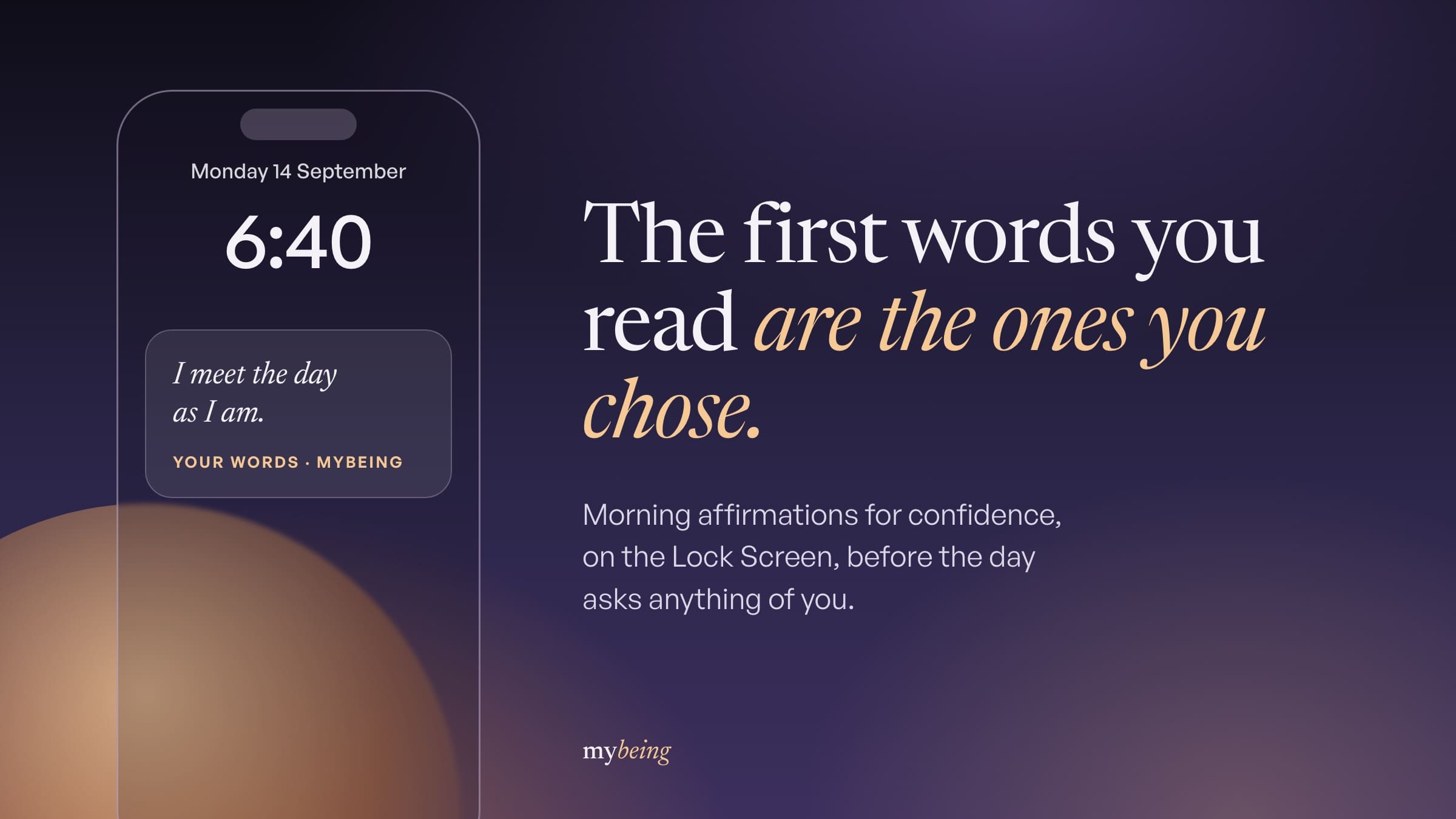
Morning affirmations for confidence are short, present-tense sentences you say to yourself before the day starts asking things of you. The ones that work are specific, believable, and said at the same point every morning for weeks.
Below are 100 of them, sorted by the moment you'll actually need them, and a plain method for choosing, writing, and keeping the ones that end up being yours.
What is a morning affirmation for confidence?
An affirmation is a sentence you say to yourself on purpose. A morning affirmation for confidence is one aimed at how you'll carry yourself today: in the 9:15 meeting, in the conversation you've been putting off since Thursday, in the mirror.
Most of what you say to yourself isn't on purpose. It's old, it's automatic, and a lot of it is unkind in a way you'd never be to a friend.
An affirmation is a small act of choosing different words, at a moment when the day hasn't chosen them for you yet.
We should say up front that there's nothing mystical in this. You are not summoning anything.
You are picking a sentence.
We make MyBeing, which sends an affirmation to your Lock Screen every day and lets you add your own, so we think about this more than most people do.
Why say your affirmations in the morning?
Because it's the one part of the day that is mostly yours. Before the first message, the first request, the first small failure, there's a window (sometimes only a few minutes, if you have children or a commute) where your attention isn't spoken for.
Confidence is also front-loaded. The hard moments tend to arrive before noon, and how you meet the first one has a way of setting the tone for the rest.
A sentence said at 7am is still there at 9. A sentence said at 10pm is mostly gone by the time you need it.
And mornings are full of anchors. The kettle, the shower, the third stair.
A habit tied to an anchor survives. A habit that floats does not, or at least ours never did.
What does the research on affirmations say?
Less than the internet claims, and more than you might expect.
Self-affirmation has been studied for decades, but the studies mostly look at something a little different from repeating a sentence. The whole field is summarised in what affirmations are.
In most of them people write for a few minutes about a value that matters to them.
Family, honesty, being good at their work. That's the "affirmation".
Cohen and Sherman's 2014 review in the Annual Review of Psychology pulled together dozens of these studies and found that brief self-affirmation exercises improved outcomes in health, education and relationships, with some effects lasting months. Cascio and colleagues (2016) put people in a scanner while they did it.
The regions that lit up were the ones tied to reward and to thinking about oneself. A year earlier, Falk and colleagues had found that people who affirmed themselves responded differently to health messages, and then, this is the part that matters, went on to change their behaviour more than the people who hadn't.
None of that says "I am confident" makes you confident. What it does suggest is that reminding yourself what you care about is not an empty gesture.
It leaves a footprint. The size of that footprint isn't the same for everyone either: the clearest result in the whole literature came out of a physics class, and we walk through it in the affirmations for women.
That's the reason the list below leans on values more than moods, and it's the reason we'd gently steer you away from affirmations about money and the universe.
I know what I stand for, and I act like it.
How do you write an affirmation you can actually believe?
The usual failure is a sentence that is too big. "I am unstoppable" is a fine thing to read on a poster and a strange thing to say to yourself at 6:40 with toothpaste in your mouth.
Your mind hears it and quietly files an objection, and after a week of objections you stop.
Four tests. They overlap a bit, which is fine.
- Present tense. "I speak clearly", not "I will speak clearly." The morning is for who you are today.
- Specific. Name the moment. "I say what I think in the standup" beats "I am assertive", every time.
- True enough. If the sentence makes you wince, soften it until it doesn't. "I am learning to trust my judgement" is honest and still moves you somewhere.
- About a value, not a verdict. "I care about doing this well" holds up on a bad day. "I am the best at this" falls over on the first one.
Some rewrites, so you can see the tests working:
- "I am fearless" becomes "I can be afraid and still go in."
- "Everyone respects me" becomes "I respect my own opinion enough to say it."
- "Today will be perfect" becomes "I can handle what today brings." (This one is on the list twice, in slightly different forms. We noticed. We left it, because it's the one people keep.)
A trick that works better than it should: write the sentence you wish someone else would say to you, then put it in the first person. Or don't.
Leaving it as "you" has seven studies behind it, which we get into in the affirmations for men.
How many affirmations should you say, and which ones?
As many as you can take in before it turns into a chore.
The number isn't the point. What matters is that the ones which land come back round, because the research is about brief, repeated reflection.
So read one group below, the one that matches the part of your day you're slightly afraid of, and say each line under your breath. Keep the ones you can say without flinching.
Skip the ones that feel like acting. If nothing fits exactly, take the nearest one and soften it with the four tests until it's yours.
Then give those ones a month of mornings. Keep reading new lines in the meantime, and let any that land join them.
100 morning affirmations for confidence
Every line here was written to pass the four tests above. Some pass more comfortably than others; you'll feel which.
Read the lot. Keep whichever ones land.
For the day ahead
Before you look at your phone, while the day is still a shape and not a list.
- I can handle what today brings.
- I do not need to be certain to begin.
- I bring something to every room I walk into.
- Today asks for my attention, not my perfection.
- I meet the first hard thing with a steady voice.
- I am ready enough.
- I choose the pace of my morning.
- What I do today is enough for today.
- I trust myself to figure out the parts I can't see yet.
- I begin before I feel ready, because that's when beginning happens.
For speaking up
The meeting. The class.
The group chat where you keep drafting and deleting.
- I say what I think, and I say it kindly.
- My questions are worth asking.
- I take my turn.
- I speak first in the standup today.
- I do not need the perfect words to have a point.
- I can be interrupted and still finish my sentence.
- My voice belongs in this conversation.
- I say the uncomfortable thing plainly.
- I ask for what I need in one sentence.
- I let silence sit instead of filling it with apology.
For the inner critic
This one starts before you're fully awake, so these are best said early. If the critic is your main problem, the self-love affirmations go deeper on it.
- I am learning to speak to myself the way I speak to a friend.
- One mistake is one mistake.
- I notice the critic and I do not hand it the microphone.
- I can be wrong without being worthless.
- I am allowed to take up space.
- I do not have to earn the right to rest.
- The story I tell about yesterday is a story, and I can tell it kindly.
- I am more than my worst hour.
- I forgive the version of me who did not know yet.
- I answer the critic with evidence.
For your values
If the research points anywhere, it points here. Confidence built on what you care about outlasts confidence built on how you happen to feel at 7am.
- I know what I stand for, and I act like it.
- I do the work because I care about it.
- I keep the promises I make to myself.
- I choose honesty even when it is slower.
- I care about doing this well, and that is enough reason to try.
- I act on what matters to me before I act on what frightens me.
- I am the kind of person who shows up.
- My values are steadier than my mood.
- I make the decision I can stand behind.
- I lead with what I care about.
For the mirror
For the first look of the day, before anyone else's eyes are on you. These are the ones people find hardest to say out loud, which is probably a reason to.
- I meet the day as I am.
- I am enough for what is in front of me.
- I choose my words, and I choose these.
- This face has carried me through every day so far.
- I look at myself without flinching.
- I do not need to be different to deserve kindness.
- I stand a little taller because I decide to.
- I am at home in myself today.
- I am not waiting to be someone else.
- Good morning. I'm glad it's you.
For work
The desk, the inbox, the task you have been circling since Tuesday. If work is where most of it lands, the affirmations for the workplace go through it moment by moment.
- I open the hard email first.
- I can do difficult things slowly.
- My work does not need to impress everyone to be good.
- I finish what I start today, even roughly.
- I ask for help before I am stuck, not after.
- I know more than I did last year.
- I can say "I don't know yet" and keep my seat at the table.
- I set one boundary today and hold it.
- I do the next small thing.
- My best today is enough for today.
For being around people
The party, the first day, the room where you don't know anyone and the person you came with has wandered off.
- I am easy to talk to because I listen.
- I do not need everyone to like me.
- I walk in and I stay.
- I introduce myself first.
- I can be quiet without being invisible.
- People are mostly thinking about themselves, and that is a relief.
- I let people see me.
- I belong wherever I decide to stand.
- I ask one real question today.
- I am good company, including for myself.
For hard conversations
The talk you've rehearsed in the shower for a week.
- I can say the true thing gently.
- I hold my ground without raising my voice.
- I can disappoint someone and survive it.
- I say no in one sentence.
- I stay in the conversation when it gets uncomfortable.
- I do not have to win to be heard.
- I can be kind and clear at the same time.
- I ask for the raise, the change, the answer.
- I speak for myself, because no one else will do it as well.
- I can end the conversation and still be a good person.
For being new at something
First week. Beginner's class.
The job you're not sure you can do.
- I am allowed to be new at this.
- Not knowing is where everyone starts.
- I ask the obvious question.
- I learn faster than I fear.
- I can be bad at this for a while and still belong here.
- I show up unfinished.
- Every expert was this clumsy once.
- I am building something that does not show yet.
- I take the next step without seeing the whole staircase.
- I trust the person I am becoming.
For after a setback
The morning after the rejection, the missed target, the thing that went wrong in front of people.
- Yesterday happened, and I am still here.
- I start again without starting over.
- I can carry disappointment without carrying blame.
- One no is not the whole answer.
- I let this be a lesson and not a verdict.
- I am allowed to try again today.
- My worth did not move.
- I did a hard thing, and it did not go well, and that is still doing a hard thing.
- I get to decide what this means.
- I am steadier than I was before this.
I am allowed to be new at this.
Where should affirmations live so you actually see them?
The sentence you can't find is the sentence you don't say. Where you keep affirmations matters more than most guides admit, and most guides don't mention it at all.
A sticky note on the mirror works until you stop seeing it, which in our experience takes about a week. A journal works if you already open it every morning.
A note in your phone works only if you remember to open the note, and you won't. (We tried a note called AFFIRMATIONS in capitals.
Opened it twice.)
The place most people look first each day is the Lock Screen of their phone. That is where MyBeing puts them.
You choose your affirmations, and they appear on your Lock Screen and Home Screen, so the first words you read each morning are ones you picked. You don't have to remember to go looking, which turns out to be the whole game.
Your first week of morning affirmations
You don't need a system. You need seven ordinary mornings, and most of them will be unremarkable.
- Day 1. Read the group that matches what scares you, and keep reading past it. Write down whatever lands.
- Day 2. Say them at your anchor: the kettle, the first look at your phone, the sink. Ten seconds. Less, probably.
- Day 3. If one line feels like acting, soften it with the four tests. Don't swap it for a new one.
- Day 4. Say them even if the morning is flat. Flat is normal. Flat is most mornings.
- Day 5. Somewhere in the day the sentence will show up on its own, usually at an odd moment. Notice it. That's the thing starting to work.
- Day 6. Say them. That's all.
- Day 7. Decide to keep going for three more weeks. Don't add more lines yet, however tempting.
Some days the words will feel true. Some days they'll feel like words.
Say them anyway. You're not trying to feel a certain way, you're practising a way of speaking to yourself, and practice is allowed to be ordinary.
A note on what affirmations are not
Affirmations are a way of choosing your words. They are not a treatment for anything, and they're not a substitute for talking to someone when you're struggling.
If your mornings are heavy in a way that words don't touch, a doctor or a therapist is the right next step, and there's no contradiction in doing both. Plenty of people do.
They're also not a way to bend the day to your will. None of the 100 lines above promise an outcome.
They describe how you intend to meet one. That's the honest version, and it's the version that holds up on a Tuesday in February.
Start small. Two sentences, one anchor, one month.
Then see what you say to yourself in week four that you didn't in week one.
Frequently asked questions
How many affirmations should I say each morning?
As many as you can read before it starts feeling like homework. The ones you can say without flinching are the ones to come back to, and coming back is where the effect sits.
Do I have to say affirmations out loud?
No. Reading them slowly works, and so does writing them down. Saying them aloud adds one more sense, which helps some people and embarrasses others.
What if I do not believe the affirmation?
Change it until you do. 'I am confident' can become 'I am learning to trust my own judgement.' A sentence you can stand behind is worth more than a bold one you cannot.
How long before morning affirmations make a difference?
Honestly, nobody can tell you. The research does not give a timeline and we would be suspicious of anyone who does. Most people notice the habit itself first, then, later, small shifts in how they talk to themselves. Give it a month before you judge it.
Is there any evidence behind affirmations?
There is a body of research on self-affirmation, mostly about reflecting on personal values. Cohen and Sherman's 2014 review found effects on health, education and relationships in several studies. It is not a treatment for anything, and MyBeing is not a medical service.
What is the difference between I am and I choose affirmations?
'I am' sentences describe who you are today. 'I choose' sentences describe a decision you are making today. If 'I am confident' feels like a stretch, 'I choose to speak first' is the same intention in a form you can act on before lunch.