Affirmations
140 positive affirmations for men, and how to make them land
140 positive affirmations for men, grouped by situation, plus the research on why swapping one word makes them work better when you're under pressure.
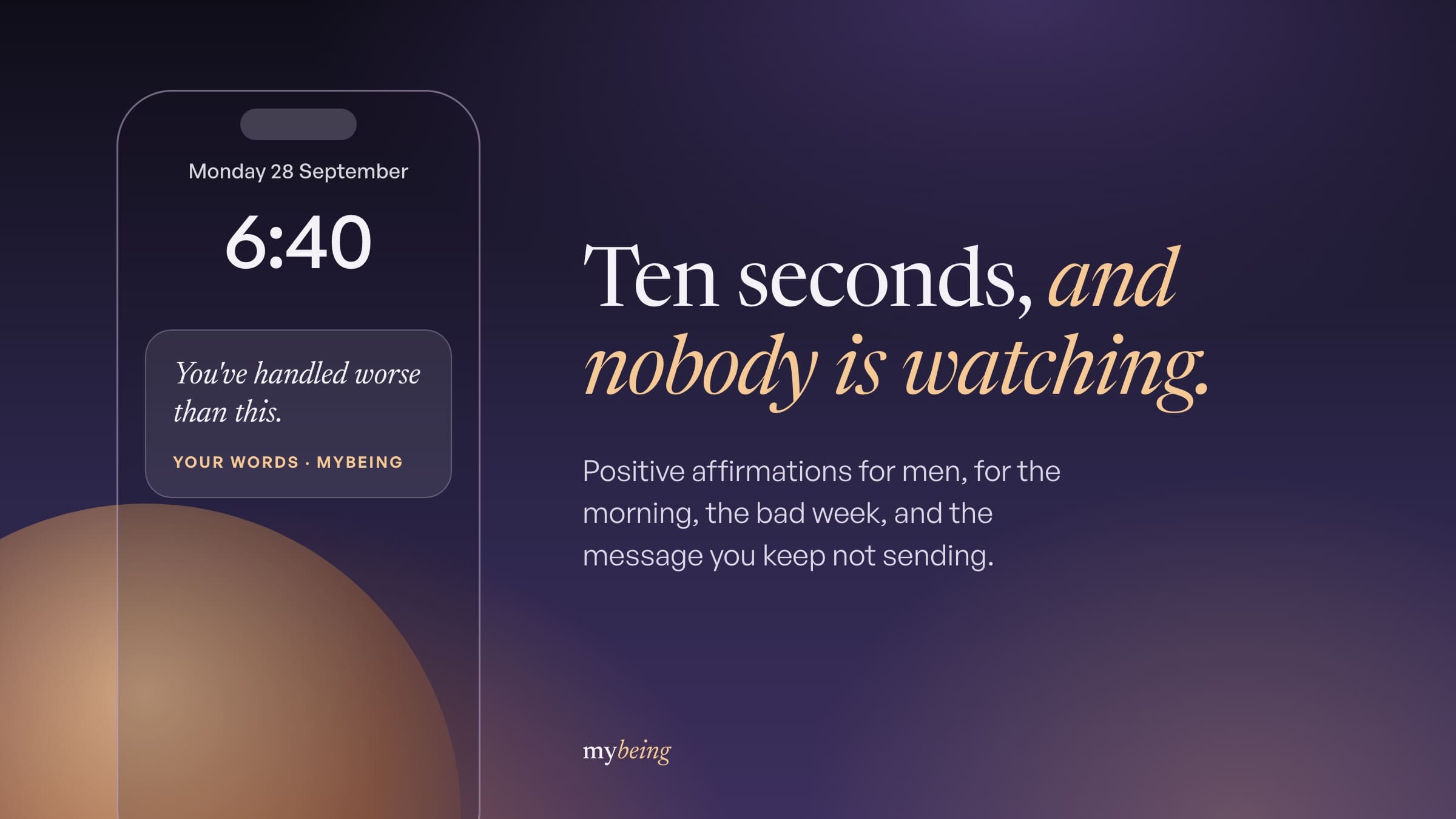
Positive affirmations for men are short, present-tense sentences you say to yourself on purpose, usually about how you intend to handle something rather than how impressive you are. If that already sounds like something you'd never do, you're the person this was written for.
Below are 140 of them sorted by situation, plus the research on why the standard "I am" format is often the wrong one, and what to use instead.
Why do affirmations feel stupid to say?
Because most affirmations are written like slogans, and because saying a flattering thing about yourself out loud is a conspicuous act.
Both of those are fixable. The slogan problem goes away when the sentence describes an action rather than an identity.
The conspicuous problem goes away when nobody can hear you. Neither has anything to do with whether it works..
We make MyBeing, which sends an affirmation to your Lock Screen each day and lets you write your own instead, and the single most common thing men tell us is a version of "I felt like an idiot for a week and then I stopped noticing." That's roughly the whole learning curve.
Does the research on affirmations actually cover men?
Less well than most pages selling this will tell you, and the honest version is more useful than the confident one.
The general findings are solid. Cohen and Sherman's 2014 review gathered dozens of studies where people wrote briefly about a value that mattered to them, and found effects on health, education and relationships, some lasting months.
Cascio and colleagues put people in a scanner in 2016 and watched reflecting on core values light up the regions tied to reward and self-processing.
Here's the part nobody competing for this search prints. When Martens and colleagues tested self-affirmation against stereotype threat in 2006, it lifted women's performance back to control levels and did nothing measurable to the men's scores.
The men in that study weren't under the same threat, so there was arguably nothing to restore. But it's a real result, it's inconvenient, and you should know it exists before anyone tells you the science is settled.
The affirmations for women take that study from the other end, where the effect did show up.
Two other things worth being straight about. What those studies tested was writing for a few minutes about something you value, not repeating a line at a mirror.
And the effect sizes are modest. This is a small, cheap habit with reasonable evidence behind it, not a lever.
What to say when "I am" affirmations feel like a lie
Change the pronoun. This is the most useful finding in the whole area and almost nobody spells it out.
In 2014, Kross and colleagues ran seven studies with 585 people. They found that how you refer to yourself while thinking something over changes how well you handle it.
Using your own name, or "you", instead of "I" creates a small amount of distance, and people who did it performed better under social stress and ruminated less afterwards.
Which means the format every affirmation list uses, "I am confident", may be the worst one for the sentence you're least able to believe. Try it the other way:
- "I am calm under pressure" becomes "You've been in worse rooms than this."
- "I am a good father" becomes "You showed up. Keep showing up."
- "I am not a failure" becomes "Dave, one bad quarter is one bad quarter."
It sounds odd written down. Said in your head at 7am, it's the difference between a claim you have to defend and a note from someone reasonable.
It's one of four fixes, and why don't affirmations work for me sets out the other three.
Use "I" for the lines you already believe and "you" for the ones you don't yet.
You've handled worse than this, and you weren't ready then either.
How to write a positive affirmation you'd actually say
Start by knowing which ones make things worse, because that's a real finding rather than a caution.
In 2009, Wood, Perunovic and Lee had people repeat "I'm a lovable person". Those who already felt good about themselves felt slightly better.
Those who didn't felt worse. The line sat too far from what they believed, and saying it mainly measured the gap.
So the most impressive-sounding option on any list is usually the wrong one for whoever needs it most. If a sentence makes your jaw tighten, that's information.
After that it's four tests.
- Present tense. "I ask for the brief", not "I'll get better at asking."
- An action, not a verdict. "I do one hard thing before lunch" survives a bad week. "I am disciplined" doesn't.
- A named moment. Where does it happen. The 9am, the drive home, the account you won't open.
- Close enough to true that you'd say it in front of someone. Not that you would. Just that you could.
If the list below feels like the problem rather than the fix, the self-love affirmations go further into what to do when every line reads false.
140 positive affirmations for men
Grouped by when you'd reach for them. Read until a few land.
A couple of these we argued about for a while and kept anyway.
For the morning
Before the day starts on you.
- I get up before I feel like it.
- Today doesn't have to be impressive.
- I set the tone for the first hour.
- Two things matter today, and I know what they are.
- I start badly and keep going.
- The first hour is mine before anyone asks for it.
- I do the first thing without negotiating with myself.
- I'm not behind yet.
- I move before I think about it too much.
- I'd rather begin than be ready.
Mornings specifically are the whole subject of our morning affirmations for confidence, if that's the part you keep losing.
For the days you're not okay
No explanation required, including to yourself.
- I'm allowed to be having a bad one.
- Nothing is wrong with me for feeling this.
- I can be struggling and still be reliable.
- I don't have to justify it to feel it.
- This is weather, not climate.
- I can tell one person.
- Getting through today is a full day's work.
- I don't have to perform being fine.
- I'll think differently about this by Thursday.
- I'm not the first man to feel like this.
For asking for help
- Asking isn't the same as failing.
- I'd want a friend to ask me.
- I say the actual thing, not the smaller version.
- Needing help is information, not a verdict.
- I can be the one who needs something today.
- Nobody is keeping score of what I've asked for.
- I say "I'm not doing great" out loud.
- Handling it alone isn't the same as handling it.
- I let someone else be useful.
- The first sentence is the hard one. After that it's a conversation.
For work
The 9am, the review, the thing you've been circling since Tuesday. The affirmations for the workplace take each of those separately.
- I do the work in front of me.
- My job is what I do, not who I am.
- I don't have to be the best in the room to belong in it.
- I say what I don't know.
- I finish it roughly rather than not at all.
- A bad quarter is a quarter.
- I ask for the brief instead of guessing.
- I do one hard thing before lunch.
- I can be ambitious and still leave at six.
- I'm allowed to be learning at this age.
For money
- My worth isn't my balance.
- I ask for the number I wrote down.
- I can talk about money without shame.
- Providing is one of the things I do, not all of it.
- I open the account instead of avoiding it.
- I can earn less this year and still be doing this right.
- I don't buy things to feel like a man.
- I say when I can't afford it.
- I make the boring decision.
- I plan for a year, not for a mood.
For being a father
- They need me present more than they need me perfect.
- I apologise to my kids when I'm wrong.
- I put the phone down for ten minutes.
- I'm allowed to find this hard.
- I'm showing them how a man handles a bad day.
- I listen for longer than is comfortable.
- I don't have to be my father.
- I can be tired and still be gentle.
- The ordinary evening is the thing.
- I say it in words, not just by turning up.
For your partner
- I say the thing instead of going quiet.
- I ask how they are, and then I listen.
- I can be wrong without it being a defeat.
- I notice out loud.
- I choose them again today.
- I don't punish with silence.
- I say what I need instead of hoping it's guessed.
- I apologise without the "but".
- I'm on their side, including mid-argument.
- I do the thing I said I'd do.
For friendship
The message you keep not sending. This group is here because no other page on this subject has one.
- I send the message I keep not sending.
- I can start the conversation.
- My friends would want to hear from me.
- I ask "how are you, actually".
- I don't wait to be invited.
- Keeping in touch is something I do, not something that happens.
- I can tell a friend something true.
- I ring instead of thinking about ringing.
- It's not too late to pick it back up.
- I make the plan.
For anger
- I feel it and I don't act on it yet.
- I leave the room instead of raising my voice.
- Anger is usually second. I ask what was first.
- I can be furious and still be fair.
- I don't take it out on whoever is nearest.
- I breathe out before I answer.
- I say I'm angry instead of demonstrating it.
- I come back and finish the conversation properly.
- Being right isn't the goal.
- I apologise for how, even when I meant what.
For your body
Training, ageing, the annual appointment you keep moving.
- This body does what I ask of it, mostly.
- I train because I like being strong, not because I hate how I look.
- I go to the doctor.
- I can be out of shape and start today anyway.
- I don't compare my body to a job description.
- Rest is part of the training.
- I sleep like it matters, because it does.
- I'm allowed to get older.
- I eat like someone I'm responsible for.
- I move today, even briefly.
For failing at something
- I did a hard thing and it didn't work.
- I can lose and stay in the game.
- One failure is one failure.
- I'd forgive a mate for this.
- I tell someone instead of going quiet.
- I look at what happened without narrating who I am.
- I start again on Monday, not in January.
- Expensive, not fatal.
- I keep the lesson and drop the rest.
- I've come back from worse than this.
For comparing yourself to other men
The feed, the group chat, the one who seems to have it sorted.
- I'm not in a race with him.
- What I see of his life is the outside of it.
- I'd still rather have mine.
- He started somewhere too.
- There's no schedule I'm behind on.
- I measure against last year.
- I can admire someone without shrinking.
- Different life, different numbers.
- I stop keeping a score nobody else is keeping.
- What I've got is worth looking at.
For the pressure to have it sorted by now
If that pressure is the kind that wakes you at 3am, the affirmations for stress relief are sorted by the moment rather than the mood.
- Nobody has it figured out.
- I'm allowed to still be working it out at this age.
- I can change direction.
- Not knowing isn't the same as failing.
- I'm building something slow.
- I don't owe anyone the plan.
- I can be uncertain and still be moving.
- The timeline was made up by someone else.
- I'm allowed to want something different now.
- I'll know more in a year than I do today.
For the days this feels like nonsense
- I'll say it anyway.
- Feeling daft doing it doesn't mean it isn't working.
- Ten seconds isn't a big ask.
- I pick the one I can actually say, and I say that one.
- I'd tell a mate to try it.
- Nobody is watching me do this.
- I've done stranger things for worse reasons.
- I gave it a month before judging it.
- Small and boring is how things work.
- It's a sentence. That's all it is.
I say the actual thing, not the smaller version.
What daily affirmations are not a substitute for
A sentence is a sentence. It isn't treatment, and it doesn't replace a conversation with a professional.
If you've been flat for weeks, if you've stopped calling anyone back, if the drink is doing a job it didn't used to do, then a doctor or a therapist is the right move and a list of affirmations is not. Those two things aren't in competition.
Plenty of men do both, and the sentences are easier to keep up once the heavier thing is being dealt with properly. What affirmations are sets out what the evidence does and doesn't cover.
And if you're reading that paragraph thinking it's about somebody else, it's worth reading again slowly. That reflex is well documented, it's part of why men get help later than they should, and no amount of morning repetition touches it.
Where to keep your affirmations so you see them
Wherever it is, it has to be somewhere you're already looking, because you will not go and seek this out on the morning you need it.
The notes app is where affirmations go to die. A printed card in a wallet does better than it sounds, at least until the wallet gets emptied.
Mirrors work for about a week and then become mirrors again. (One of us tried a Post-it on the bathroom cabinet and can confirm it was invisible by the following Friday.)
Your Lock Screen is the one thing you look at before you look at anything else, usually before you've spoken to another human being. That's where MyBeing puts them.
A line turns up on its own each day, and you can swap in wording of your own when the one that arrives isn't the one you need. The whole thing takes the ten seconds between picking up the phone and putting it down.
Your first week of daily affirmations
- Day 1. Start with the group matching what you're actually dealing with, then keep reading. Hold on to what lands.
- Day 2. Say them at a fixed point. Kettle, first look at the phone, the car before you go in.
- Day 3. If one feels false, shrink it or switch it to "you". Don't swap it for a new one.
- Day 4. Say them on the flat morning too. Most mornings are the flat ones.
- Day 5. One will turn up on its own, usually right after something irritating. That's the thing starting to work.
- Day 6. Say them.
- Day 7. Another three weeks before you decide anything.
Most men who stick with this don't report feeling different so much as noticing they've stopped saying something they used to say to themselves constantly. That's a quieter result than the internet promises, and it's the one that lasts.
Frequently asked questions
Why do affirmations feel stupid to say?
Mostly because the standard ones are written like slogans, and because saying something flattering about yourself out loud is a conspicuous thing to do. The awkwardness is about the format and the audience, not about you. Pick a plainer sentence and say it where nobody can hear you.
What do I say when "I am" feels like a lie?
Change the pronoun. Kross and colleagues ran seven studies in 2014 and found that referring to yourself as "you", or by your own name, creates a bit of distance and helps people handle stress better than "I" does. "You've handled worse than this" is easier to say than "I am resilient", and it's the version with the evidence behind it.
Is there research on affirmations specifically for men?
Less than you would think. The self-affirmation literature is large, but a well-known 2006 study found the effect lifted women's performance under stereotype threat and did not move the men's scores at all. Most of the general findings are not sex-specific. Anyone telling you the science is settled for men is overselling it.
Does it work if I don't say them out loud?
Reading them counts. So does writing them down. Out loud adds something for some people and is unbearable for others, and there is no prize for the harder version.
How long before anything changes?
Nobody can give you a number, and we would not trust a page that did. What most people notice first is the habit, and then, weeks in, that the running commentary in their head has got a little less harsh. Give it a month.
Are these a substitute for therapy?
No. They're a way of choosing your words, and that's the whole claim. If things are heavier than that, talk to a doctor or a therapist. MyBeing is not a medical or mental health service.