Affirmations
70 positive affirmations in the workplace, and what they can't fix
70 positive affirmations in the workplace, sorted by the moment, plus the research on problem-solving under stress and the honest limits of what words fix.
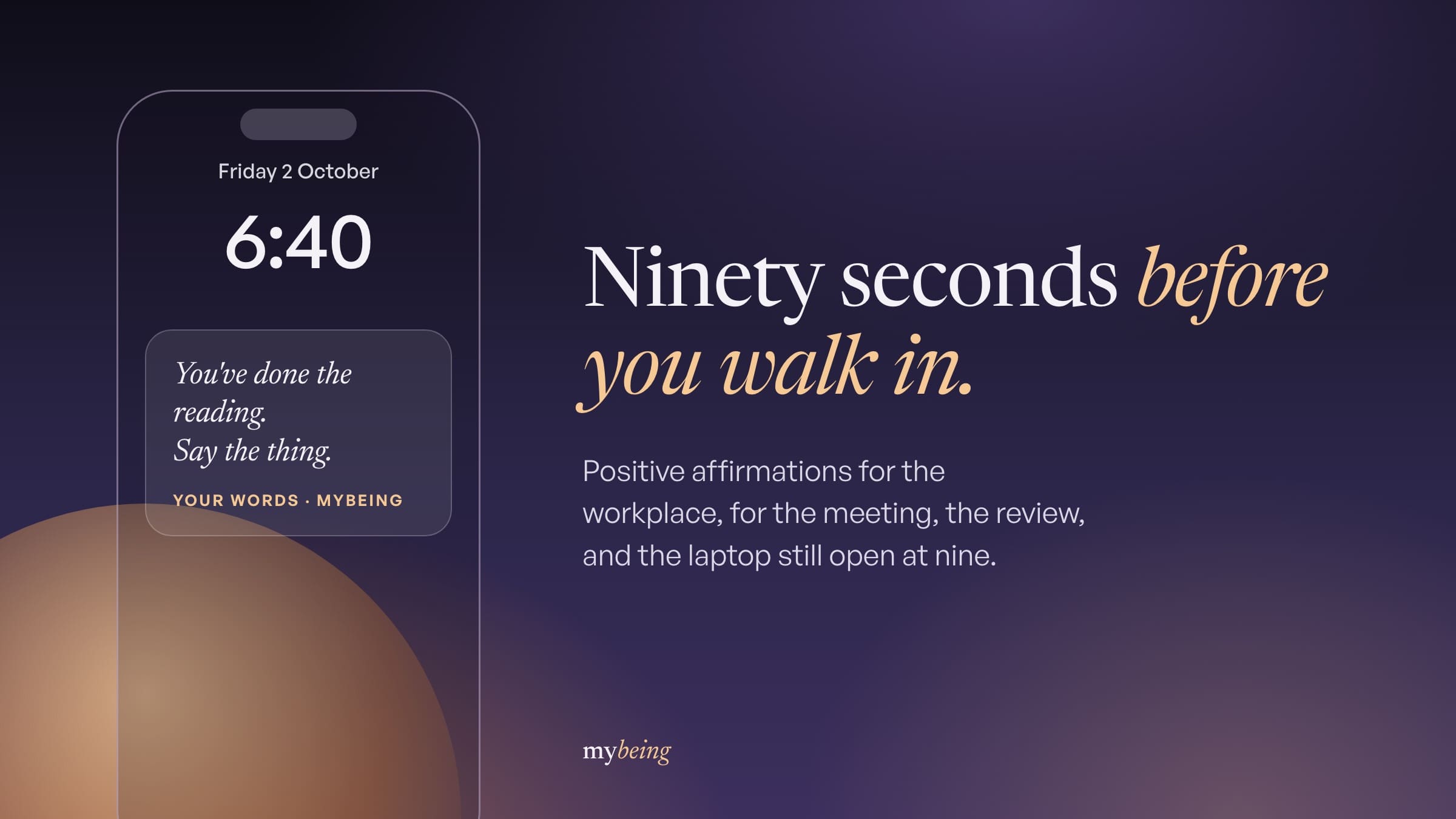
A positive affirmation in the workplace is a short sentence you say to yourself before a particular work moment, usually about how you intend to handle it. Not a slogan about loving your job.
Below are 70 positive affirmations in the workplace, grouped by the moment you'd reach for one, what the research says about using them under pressure, and a straight answer about the things no sentence is going to fix.
What counts as a positive affirmation in the workplace?
A sentence you choose, said before a moment you didn't choose.
That's narrower than most lists on this subject, deliberately. "I am a valued member of this team" is a claim about other people's opinions and you have no way to verify it at 10:55.
"I've done the reading and I can say so clearly" is about you, it's checkable, and it fits in the walk to the meeting room.
We make MyBeing, which sends an affirmation to your Lock Screen daily and lets you write your own, so we end up reading a lot of workplace affirmation lists. Most of them are written as if work were a motivational problem.
Mostly it's a pressure problem, and pressure is a different thing to prepare for.
Do positive affirmations at work actually do anything?
There's one study that matters more than the rest for this particular question, and it's about stress rather than success.
In 2013, Creswell and colleagues took people who were chronically stressed and had some of them spend a few minutes writing about a value that mattered to them. Everyone then did a problem-solving task under pressure.
The group that had done the writing performed significantly better. Not happier.
Not more motivated, which is what you'd expect a positivity exercise to deliver. Better at thinking while stretched, which is a stranger and more useful result.
That's the finding worth carrying into a Tuesday. Work stress, most of the time, is exactly this: being asked to think clearly while carrying more than is comfortable.
The wider picture is consistent with it: Cohen and Sherman's 2014 review gathered dozens of these studies and found effects on health, education and relationships, some lasting months, and Cascio and colleagues watched the same exercise light up reward and self-processing regions in a scanner in 2016.
Two honest caveats, because every page competing for this search skips them. The wider evidence base is in what affirmations are.
What was tested was a few minutes of writing about your values, not a mantra at your desk.
And the effects are modest. This is a cheap habit with real evidence behind it, not a performance lever.
You'll also see a claim going around that 60 to 70 percent of self-talk is negative, usually credited to an unnamed university. We spent an afternoon looking for the study and came up with nothing but other blog posts citing each other.
Treat it as folklore.
You've done the reading. Say the thing.
What do you say in the ninety seconds before you speak?
Change the pronoun. This is the most practical finding in the whole area and it's a near-perfect match for the before-a-meeting moment.
Kross and colleagues ran seven studies in 2014 with 585 people, several of them built around preparing to speak in front of others. How you refer to yourself while thinking it over turned out to change how well you cope.
Using "you", or your own name, instead of "I" creates a small amount of distance, and people who did it handled the social stress better and chewed it over less afterwards.
So in the corridor, "you've been in worse rooms than this" does more than "I am confident". The method goes further in our affirmations for men, where it's the spine of the post, but it isn't male-specific and it's most useful right here, in the ninety seconds before you start talking.
Which work affirmations backfire?
The ones you'd be embarrassed to be caught believing.
The classic demonstration dates to 2009, when Wood, Perunovic and Lee asked people to repeat the line "I'm a lovable person" and then measured the damage. For participants with high self-esteem it nudged things upward a little.
For everyone else it went the other way, because a sentence sitting well outside what you believe mostly draws your attention to the distance.
At work this shows up as a specific failure. "I am thriving in my role" said by someone who dreads Sunday evening does not produce thriving.
It produces a quiet inventory of all the ways that sentence is false. Shrink it until it's true: "I'm good at the part of this I'm good at" will hold up on a bad Monday.
Then there's the related trap, which is any affirmation that quietly requires your employer to behave well. "My contributions are recognised" is not an affirmation.
It's a hope about somebody else.
How do you write a work affirmation you'd say at your desk?
Four tests, and they're stricter at work than anywhere else because the environment keeps providing evidence against you.
- Present tense, about an action. "I ask the question I came in with", not "I will become more assertive."
- Entirely within your control. Nothing that depends on a manager noticing.
- Attached to a moment. The 11am. The one-to-one. The reply-all you're drafting.
- Survivable on a bad day. If a single piece of critical feedback would make it absurd, it's too big.
Three rewrites:
- "I am respected here" becomes "I say what I think, clearly, and once."
- "My job is my purpose" becomes "I do work I can stand behind, most days."
- "I am never stressed" becomes "I can be stressed and still think straight."
70 positive affirmations in the workplace
Sorted by the moment. Start with the thing you're dreading this week.
Then keep going, and hold on to whichever ones land.
Before the meeting
The 11am, the pitch, the presentation where everyone's camera is on.
- You've done the reading.
- I say my point once, clearly, and then I stop.
- I don't need the perfect sentence to make a good point.
- You've been in worse rooms than this.
- I can be nervous and still be useful.
- I'm here because someone wanted my view.
- I ask the question I came in with.
- If I lose my thread, I pause and pick it back up.
- Nobody is tracking this as closely as I am.
- I finish my sentence.
After criticism
The review, the correction in front of people, the message that just said "can we talk".
- I can take feedback without taking it personally.
- One piece of criticism is one piece of criticism.
- I ask what specifically, before I decide what it means.
- I'm allowed a day to feel annoyed about this.
- Being told to improve something isn't being told I'm bad at everything.
- I'd want to know. Now I know.
- I separate the work from the person who did it.
- "Areas for development" is a phrase, not a verdict.
- I can disagree and say so, calmly, tomorrow.
- This will matter less in a month than it does at four o'clock today.
When the workload is impossible
For the Sunday-night version of the list, and the overwhelmed Wednesday version. When the pressure isn't only coming from work, the affirmations for stress relief take it more broadly.
- I do the next thing, not all the things.
- I can only be in one place, doing one task.
- I say what won't get done, early, in writing.
- The list being long isn't evidence that I'm slow.
- I'd rather deliver three things properly than eight badly.
- Nobody is served by me working until nine.
- I ask what comes off the list if this goes on it.
- I can be behind and still be competent.
- I stop at a sensible point rather than a finished one.
- Being busy isn't the same as being valuable, and I don't have to perform it.
When you feel out of your depth
Imposter syndrome, if you want the term for it. The meeting where everyone seems to know a thing you don't.
- I'm new at this specific thing, not at everything.
- I ask the obvious question. Someone else needed it asked.
- I knew less a year ago and managed.
- "I don't know yet" is a complete professional sentence.
- Feeling out of my depth usually means I'm learning something.
- They hired me knowing what I knew.
- I can look it up afterwards without announcing that I'm looking it up.
- Everyone in this room has bluffed something.
- I'd rather ask and be briefly awkward than guess and be wrong for a month.
- I'm allowed to still be getting the hang of this.
For the difficult colleague
- I can be civil without being warm.
- Their tone is about their day.
- I respond to what was said, not what I think was meant.
- I don't rehearse arguments I'm not going to have.
- I keep it in writing and keep it polite.
- I don't need them to like me to do this job.
- I can raise it properly instead of carrying it.
- Reply-all is rarely the answer.
- I'm not responsible for managing their mood.
- Not every slight needs a response. Some need a note in a file.
For switching off
Boundaries, in the unglamorous sense. The laptop still open at nine, the Slack notification on a Sunday.
- The work will still be there, and so will I.
- I close it at a time I choose.
- Thinking about it this evening won't finish it.
- I'm paid for my hours, not my attention span.
- Tomorrow's version of me is better at this than tonight's.
- I don't check it from bed.
- The thing I'm worrying about takes nine minutes in the morning.
- I'm allowed an evening with nothing in it.
- Being reachable isn't part of the job description I signed.
- I put it down. That's the whole skill.
For the new job or the first week
- Nobody expects me to know where anything is.
- I write things down rather than trusting I'll remember.
- I'm allowed to ask the same question twice.
- Three months from now this will be ordinary.
- I introduce myself first.
- I don't have to prove it all in week one.
- Learning the room is part of the work right now.
- I can be quiet while I'm figuring out how it runs here.
- The version of me they hired is enough to start with.
- I'd tell someone else in my position to relax, so I will.
I can be stressed and still think straight.
What positive affirmations can't fix at work
This is the part the rest of the internet skips, and it's the part that matters most if you're reading this at your desk feeling sick.
A sentence will not fix being underpaid. It will not fix a manager who presents your work as theirs, a workload that no competent person could carry, or a culture where people shout.
If you're heading for burnout, a sentence is not the intervention. Those are facts about a job.
Saying something kind to yourself on the walk in does not alter any of them, and a page that implies otherwise is quietly converting your employer's problem into your attitude problem.
What the sentence changes is the second conversation. Not the meeting, the negative self-talk that starts afterwards and runs all evening, where you decide what the whole thing says about you.
That one is genuinely yours, and it's worth getting your hands on. Creswell's stressed participants still had the same hard task in front of them.
What changed was how well they could think while doing it.
So use the affirmations for the thinking, and use something else for the job. Sometimes the something else is a conversation with your manager.
Sometimes it's a union, or HR, or a doctor if the stress has started showing up in your body. Sometimes, honestly, it's a different job.
None of those are failures of mindset. If work has stopped being survivable, a professional is the right next call, and MyBeing is not a medical or mental health service.
If the voice doing the running commentary is the actual problem, our self-love affirmations deal with that directly rather than with the job.
Where to keep your work affirmations
Somewhere private and somewhere you were already looking. Those two conditions rule out almost everything people suggest.
A sticky note on the monitor fails the privacy test, and in an open-plan office it fails it loudly. The notes app on your phone fails the second one, because you'll never open it between a bad meeting and the next bad meeting.
A card in a drawer is nice and you will look at it in week one. (We know someone who wrote one on the back of a laminated fire-evacuation card.
Two of their colleagues eventually asked about it, which rather defeated the purpose.)
Your Lock Screen passes both. It's already in your hand forty times a day, it's the thing you check walking between rooms, and nobody can read it over your shoulder from across a desk.
That's where MyBeing puts them: one arrives each day, and you can write your own for the week you're actually having.
Your first week of workplace affirmations
- Monday. Look at next week's calendar. Find the thing you're least looking forward to. Take one line from that group.
- Tuesday. Add one general line. That's two. Stop there.
- Wednesday. Say them on the way in, not at your desk. Ten seconds, in your head. (The hour before the commute is a separate problem, and the morning affirmations for confidence are about that one.)
- Thursday. Try the second person on the harder one. "You've done the reading" rather than "I've done the reading".
- Friday. If one of them felt like a lie all week, shrink it rather than replacing it.
- The weekend. Don't do anything. The habit shouldn't own your Saturday.
- The following Monday. Same two lines. Changing them is the most convincing way to stop doing this.
There's no moment where any of this announces itself, so don't wait for one. The clearest sign, when it turns up, is arithmetic.
The twenty minutes you used to spend after a bad meeting rewriting it in your head becomes about four. Nobody at work will notice.
You get the other sixteen minutes back, which over a year is a working week you didn't spend arguing with somebody who wasn't there.
Frequently asked questions
Do positive affirmations actually help at work?
The useful evidence is about stress rather than success. Creswell and colleagues found in 2013 that chronically stressed people who spent a few minutes writing about a value they held then performed better on a problem-solving task under pressure. That's a modest, real effect on how you think when you're stretched, which is most of what work stress actually consists of.
What should I say before a presentation or a difficult meeting?
Something short, and preferably in the second person. Kross and colleagues studied exactly this kind of moment and found that saying "you've prepared for this" rather than "I've prepared for this" helps people handle social stress better. Say it once in the corridor, not ten times at your desk.
Isn't this just toxic positivity?
It is, if the sentence asks you to feel good about something bad. "I love every part of my job" is toxic positivity. "I can get through this week and then look at my options" is not. The difference is whether the line denies the problem or describes how you'll carry it.
Can my affirmations fix a job I hate?
No, and it's worth being blunt about it. If you're underpaid, overloaded, or working for someone who takes credit for your work, those are facts about the job. A sentence changes how you talk to yourself about them. It doesn't change them, and anyone implying otherwise is making your employer's problem into your mindset problem.
Should I say them out loud at my desk?
Please don't. Read them. The whole thing works better in private, which is most of the reason it lives on a phone screen rather than a sticky note where your colleague can see it.
How many work affirmations should I use?
Start with the moment you dread most this week, then keep reading until a few more land. The ones that land are the ones worth meeting every morning, and that repetition is the part that works.