Guides
The 8 best affirmation apps, and who each one is for
There is no single best affirmation app. Here are 8, what the research says to look for, and which one suits which kind of person.
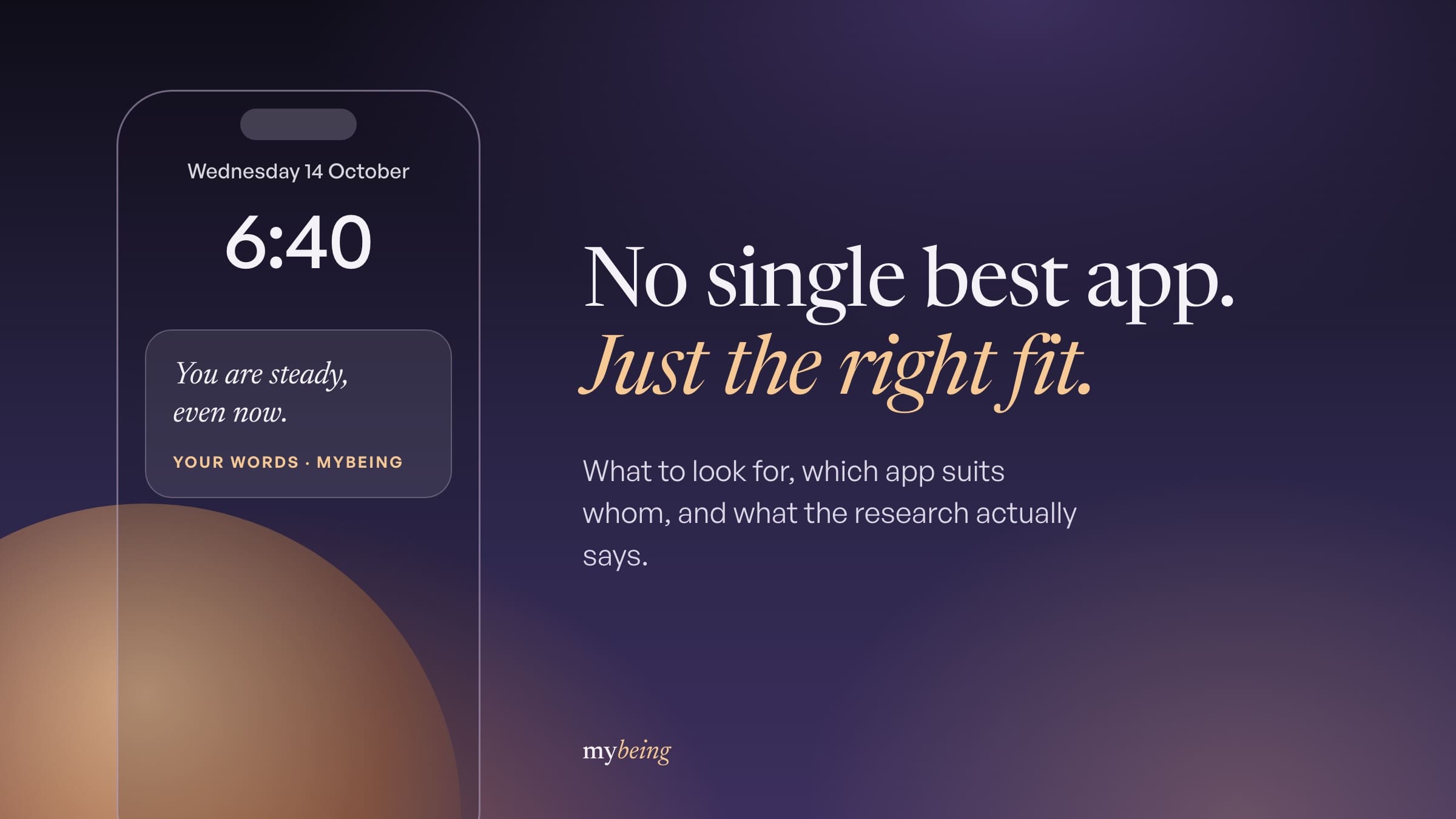
There is no single best affirmation app, and any list that names one is dodging the real question. The right app depends on how you want to meet the words: read them on your Lock Screen, hear them in your own voice, say them out loud, or write them yourself.
This guide sorts the main apps by that choice. It also covers the two things these lists almost never mention, which are what the research says about how affirmations actually work and when they can misfire.
What makes the best affirmation app for you
Start with delivery, not the feature list. An app you have to remember to open will fade by week two.
So how the words reach you matters more than how many there are.
Four things decide whether an app sticks. Do the words arrive on their own, can you change them, whose voice says them, and does the free tier let you practise at all?
Delivery is the one people underrate. A line on your Lock Screen gets seen on the days you least feel like opening anything.
Those are the days it counts.
Being able to change the words comes second. Someone else's line, written for a life you don't have, is easy to swipe past.
Most apps let you write your own, though it's often buried in the settings.
The evidence under all this is about the practice, not any product. Cohen and Sherman's 2014 review found that short self-affirmation tasks improved how people did in health, school and relationships, sometimes months later.
What no study has done is compare one app with another. So treat every ranking, this one included, as a guide to fit rather than proof of quality.
Who publishes these lists, and why it matters
Four of the five pages that rank for this phrase are published by companies that make an affirmation app. In three of them, the winning app belongs to the people who wrote the page.
We're in the same boat. MyBeing is ours, made by Enthuworks Inc, so read our bit with that in mind.
Soma, one of those rival pages, says this straight out in its opening line. Credit where it's due.
We won't pretend to be neutral. What we can do is tell you what each app is shaped for, and say plainly where ours is the wrong pick.
The 8 best affirmation apps, grouped by how you practise
Prices and features below were checked in October 2026. They change often and differ by country, so look at your own store page before paying for anything.
These are numbered for reading order, not merit. Ours is first because it's ours, and the other seven are here because each one beats it for somebody.
We also checked when each app last shipped an update, which no other list on this subject seems to bother with. An app can still be good months after its last release, but a long gap tells you something about whether anyone is still looking after it.
Two of the eight are overdue, and we've said so in their entries.
1. MyBeing, for being walked through it rather than handed a list
Most apps on this page give you a card and leave the rest to you. MyBeing reads the day's affirmation aloud and builds a short breathing cycle around it, so the practice has a beginning and an end.
You can write your own lines too, and decide whether they mix in with the day's set, come first, or are the only ones you see. There are 81 topics, and a tone setting that changes the words between "I am" and "you are".
It's free to start on iPhone and Android, with a paid tier for the rest. Last updated 2 October 2026.
Being straight about it: MyBeing launched this year and has a handful of ratings, against I Am's 735,000. If a long track record is what you want, we aren't it yet.
2. I Am, for the biggest library and the most polish
The most established app in the category, with 4.8 stars from 735,000 ratings, a very large library and widgets that work properly. If you want the safe, well-trodden choice, this is the one.
Two things to weigh before you install. Its App Store listing names advertising among the app's contents, and paid tiers reached $59.99 a year or $149.99 for life.
Last updated 6 October 2026, so it's actively maintained. Worth knowing that Motivation, number 8 below, comes from the same developer and shipped the same version number on the same day.
3. ThinkUp, for hearing the words in your own voice
ThinkUp has you record the affirmations yourself, then plays them back over music. Hearing your own voice say the line is a different experience from reading it, and for some people that's what makes it land.
The free tier is tight: three recorded affirmations and one background track. That's still enough to find out whether the method suits you, which is all a free tier really has to do.
One caution, and it's the reason this app isn't higher. ThinkUp was last updated on 3 August 2025, which is more than a year ago.
The app still runs and the method still stands. But a year without a release means no fixes when iOS changes under it, so think hard before buying the lifetime tier.
4. Innertune, for listening rather than reading
Built around audio, so it fits a walk, a commute, or the half hour before sleep. The paid tier advertises 22,000 affirmations, more than 550 playlists and a choice of voices.
Pick it if you'd rather not look at a screen. It's also the easiest one to let turn into background noise, which is the risk with anything you play while doing something else.
Last updated 6 October 2026, and shipping regularly.
5. Mantra, for wanting the thing to feel calm
Simple cards, soft audio, careful typography. That sounds like decoration until you remember that an app which feels like a chore gets deleted in week two.
It's usually listed as iPhone only, so check before you plan a routine around it. The library is smaller than I Am's, which is the trade for the quieter feel.
A smaller caution than ThinkUp's, but the same kind. Mantra was last updated on 25 April 2026, around six months ago, which is slow for an app charging a yearly fee.
6. Gratitude, for people who already journal
Puts affirmations beside journal entries, prompts and a vision board, so the line connects to something you actually wrote. If you already keep a journal, that's one app instead of two.
The trade is density. There's more to learn here than in a single-purpose app, and more to ignore once you've found the two features you want.
The most recently updated app on this page, at 8 October 2026, and the best rated at 4.88 from nearly 45,000 ratings.
7. Believe, for saying them out loud
Built around speaking affirmations rather than reading them, including a mode where you say them while looking at your own face. People split hard on this one.
Give it a single day before you judge it. Either the directness works for you or it makes you want to put the phone down, and you'll know almost immediately.
Last updated 17 September 2026. It's the smallest app here by audience, with a few hundred ratings rather than tens of thousands.
8. Motivation, for a lift rather than a practice
Serves quotes rather than first-person affirmations, which makes it a different thing in similar clothing. Someone else's words can pick you up, but they don't do what repeating your own line does.
Choose it if you want pleasant interruptions through the day. Skip it if you want a practice.
It has the largest audience of anything here, at more than a million ratings, and was last updated 6 October 2026. Same developer as I Am, which explains why the two feel so alike.
What should an affirmation app cost?
Every major affirmation app is free to download and sells a paid plan. So the download price tells you nothing.
What varies is how much of the practice sits behind the wall.
The spread is wide. Yearly plans ran from about $35 to about $60 when we checked, and some apps sell a one-off lifetime plan from roughly $80 to $150.
Lifetime deals deserve a pause. They look thrifty, and they only pay off if you still open the app in a year (on current habits, most people won't).
There's also the ad question, and the store page answers it before you install. Apple lists advertising under what an app contains, so you can check without downloading.
Our advice: pay nothing in week one. If an app can't hold you for a fortnight on its free tier, a yearly plan won't fix that.
Does a big affirmation library matter?
Less than the marketing suggests. A library of 20,000 lines is the easiest thing to advertise and the hardest to show matters.
Think about how you actually use one. You want a handful of lines that fit your life this month, not a catalogue to browse.
There's a point where more gets worse. Scrolling a huge list is a decision every morning, and decisions are what kill daily habits.
Where size does help is range. If your life needs words about money, a new baby and a hard manager, a thin library runs out fast.
That's a fair reason to prefer a bigger one.
Should your affirmations say "I am" or "you are"?
This is the choice nobody asks about, and it may matter more than the app itself. Most apps give you first-person lines only.
Kross and colleagues found in 2014 that people who spoke to themselves as "you", or by name, handled stress better than people who used "I". The shift seems to put a little distance between you and your own feelings.
I am steady, even now.
You are steady, even now.
Read both and notice which one you believe. We go further into this split in the post on affirmations for men.
If one wording feels false and the other doesn't, that's useful. MyBeing lets you pick the tone, which is why this section is here at all.
When an affirmation app is the wrong choice
Sometimes it is, and no list on this subject seems willing to say so. Wood's 2009 study found that people who already felt bad about themselves felt worse after repeating a kind line about themselves.
That should change how you shop. The warmest, most flattering app isn't automatically the kindest one for you.
A line far from what you believe can push you the wrong way.
The fix is usually smaller words, not no words. "I am learning to speak kindly to myself" lands easier than "I love myself completely", and we work through that in why affirmations don't work for some people.
How to test an affirmation app without wasting money
Download two, not six. Pick the two whose delivery style matches how you want to meet the words, and give each a fortnight.
Ask the free tier the hard question. Can you do the core practice without paying, or does it stop you after three days?
A trial is not a free tier. That difference is where most of the annoyance in this category lives.
Then wait longer than feels natural before judging. A 2025 review that pooled 129 tests from 67 earlier studies, covering nearly 18,000 people, found the effects were often bigger after the practice ended than during it.
That's the trap in app shopping. You'll want a verdict in four days.
But the honest timeline is longer, which is why a free tier you can live in for a month beats a cheap annual plan bought on day one.
Frequently asked questions
What is the best free affirmation app?
All of the main affirmation apps are free to download, so the real question is what the free tier gives you. Some let you use the core practice for free and charge for extra themes or voices. Others stop you after a few days, which is a trial rather than a free tier.
Do affirmation apps actually work?
The research is about the practice, not the apps. Cohen and Sherman's 2014 review found that short self-affirmation tasks improved outcomes in health, school and relationships, sometimes months later. No study has tested whether one app works better than another.
Is the I Am app free?
I Am is free to download. Its App Store listing names advertising among the app's contents, and its paid tiers ran to $14.99 a month, $59.99 a year and $149.99 for lifetime access when we checked in October 2026.
Which affirmation app is best for Android?
Fewer affirmation apps support Android well, and several of the best known ones are iPhone only. I Am, ThinkUp, Gratitude and MyBeing all run on both, so start there if you are on Android.
How long should I use an affirmation app before deciding?
Two weeks is a fair test. A 2025 review that pooled 129 earlier tests found that effects were often larger after the practice ended than during it, so a week is too short to judge.
Which affirmation apps are still being updated?
When we checked in October 2026, Gratitude, I Am, Innertune, Motivation, MyBeing and Believe had all shipped an update within the previous month. Mantra was last updated in April 2026 and ThinkUp in August 2025, so both are worth a second thought before you buy a yearly or lifetime plan.